MCQ
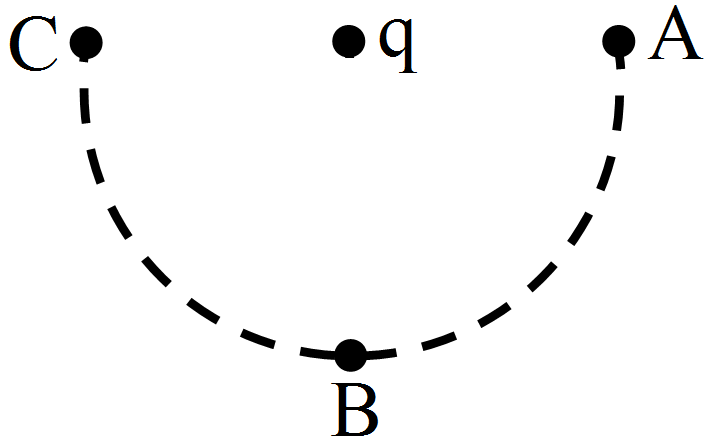
For a single charge the field lines start or ends at:
  • A
    Positive charge.
  • B
    Negative charge.
  • C
    Infinity.
  • D
    None.

Answer

  1. Infinity.

Need a full question paper?

Generate a complete, print-ready paper with questions like this in minutes — across 16+ boards, with answer keys.

Start Generating Free

Similar questions

M, Mn​ and Mp​ denotes the masses of a nucleus of Z​XA, a neutron, and a proton respectively. If the nucleus is separated into its individual protons and neutrons then,
For harder X-rays:

Time period for a magnet is T. If it is divided in four equal parts along its axis and perpendicular to its axis as shown then time period for each part will be

(a) 4T  

(b) T/4

(c) T/2     

(d) T

Two equal positive charges are kept at points A and B. The electric potential at the points between A and B (excluding these points) is studied while moving from A to B. The potential.
  1. Continuously increases.
  2. Continuously decreases.
  3. Increases then decreases.
  4. Decreases then increases.

Which of the following logic gate is an universal gate

(a) OR

(b) NOT

(c) AND

(d) NOR

A long, straight wire carries a current i. The magnetizing field intensity H is measured at a point P close to the wire. A long, cylindrical iron rod is brought close to the wire so that the point P is at the centre the rod. The value of H at P will:
  1. Increase many times.
  2. Decrease many times
  3. Remain almost constant.
  4. Become zero.
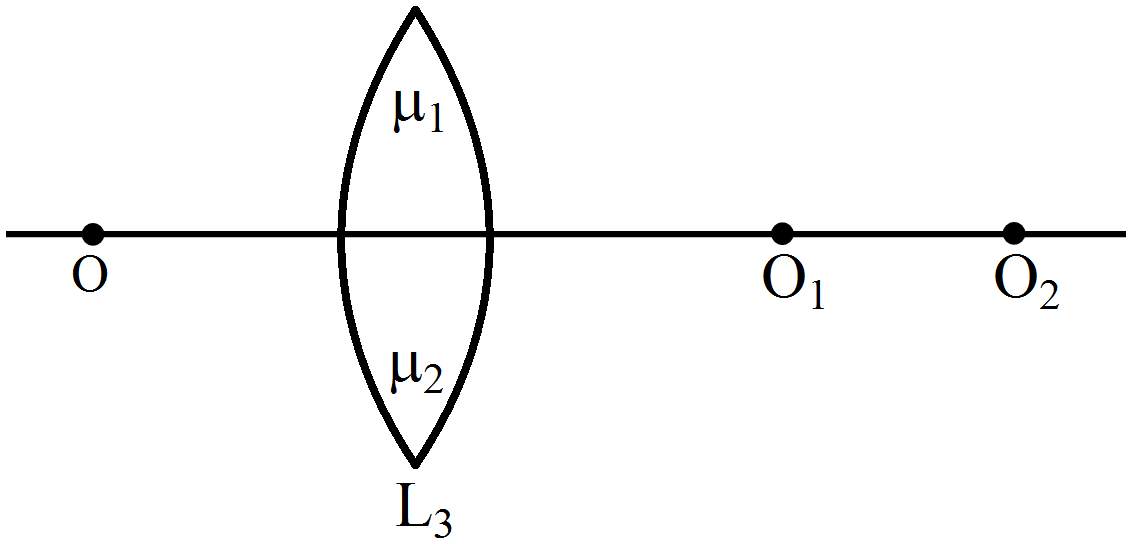
Consider three converging lenses L1, L2 and L3 having identical geometrical construction. The index of refraction of L1 and L2 are $\mu_1$ and $\mu_2$ respectively. The upper half of the lens L3 has a refractive index $\mu_1$ and the lower half has $\mu_2$. A point object O is imaged at O1 by the lens L1 and at O2 by the lens L2 placed in same position. If L3 is placed at the same place:

  1. There will be an image at O1
  2. There will be an image at O2
  3. The only image will form somewhere between O1 and O2
  4. The only image will form away from O2.

Which of the following waves have the maximum wavelength

(a) X-rays            

(b) I.R. rays

(c) UV rays

(d) Radio waves

If T is the half life of a radioactive material, then the fraction that would remain after a time   is

(a)   

(b)  

(c)  

(d)