MCQ
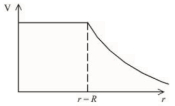
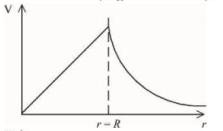
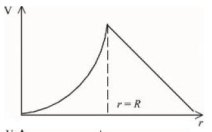
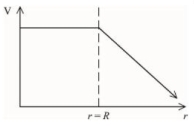
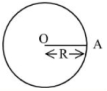
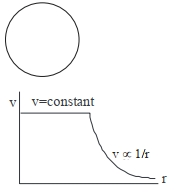
For a uniformly charged thin spherical shell, the electric potential $(V)$ radially away from the center $(O)$ of shell can be graphically represented as
  • B

  • C

  • D

Answer

Correct option: A.

a
$V_{\text {inside }}=\frac{ kQ }{ R }$

$V _{\text {outside }}=\frac{ kQ }{ r }$
Need a full question paper?

Generate a complete, print-ready paper with questions like this in minutes — across 16+ boards, with answer keys.
Start Generating Free

Similar questions

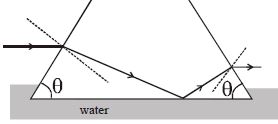
A glass prism whose cross-section is an isosceles  triangle stands with its (horizontal) base in water; the angles that its two equal sides make with the base are each $\theta$. An incident ray of light, above and parallel to the water surface is totally internally reflected at the glass-water interface and subsequently re-emerges into the air. Take the refractive indices of glass and water to be $\frac{3}{2}$ and $\frac{4}{3} $ , respectively. Maximum value of $cos\theta$ is.        
The minimum frequency $\nu $ of continuous $X-$ rays is related to the applied potential difference $V$ as
Two coils have a mutual inductance 0.005 H. The current changes in the first coil according to equation $I = I _0 \sin$ $\Omega t$, where $I _0=10 A$ and $\omega=100 \pi rad s ^{-1}$. The maximum value of emf in the second coil is
If an electric dipole is placed in a non-uniform electric field then :
Which of following can not be polarised
Assertion : Bohr had to postulate that the electrons in stationary orbits around the nucleus do not radiate.
Reason : According to classical physics all moving electrons radiate
In a certain region of space, the potential is given by : $V = k[2x^2 - y^2 + z^2].$ The electric field at the point $(1, 1, 1) $ has magnitude =
A charged cork of mass $m$ suspended by a light string is placed in uniform electric filed of strength $E= $$(\hat i + \hat j)$ $\times$ $10^5$ $NC^{-1}$ as shown in the fig. If in equilibrium position tension in the string is $\frac{{2mg}}{{(1 + \sqrt 3 )}}$ then angle $‘\alpha ’ $ with the vertical is
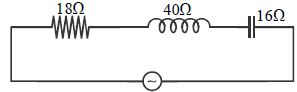
The impedance of the given circuit is......$\Omega $
Light is incident normally on a diffraction grating through which the first order diffraction is seen at $32^\circ$. The second order diffraction will be seen at