MCQ
For question, two statements are given$-$one labelled Assertion and the other labelled Reason. Select the correct answer to these questions from the codes $(a), (b), (c)$ and $(d)$ as given below.
Assertion: Initiation step of protein synthesis in prokaryotes and eukaryotes has several differences.
Reason: They both form $\text{mRNA - tRNA}$ complex with smaller subunit of ribosome.
  • A
    Both assertion and reason are true, and reason is the correct explanation of assertion.
  • Both assertion and reason are true, but reason is not the correct explanation of assertion.
  • C
    Assertion is true, but reason is false.
  • D
    Both assertion and reason are false

Answer

Correct option: B.
Both assertion and reason are true, but reason is not the correct explanation of assertion.
The differences between initiation step of protein synthesis in eukaryotes and prokaryotes are : $(i)$ In prokaryotes initiation factors are three $IF1, IF2$ and $1F3$. Eukaryotes have at least ten initiation factors $- \text{eIF1, eIF2, eIF3, eIF4A, eIF4B eIF4C, eIF4D, eIF4F eIF5}$ and $\text{eIF6}$
$(ii)$ In eukaryotes, fonnylation of methionine does not take place. In prokaryotes $\text{tRNA}$ is charged with formylated methionine. $(iii)$ The larger subunit of ribosome combines with $40 S- \text{mRNA-tRNA}$ Met $($in case of prokaryotes, $30 S)$ complex to form intact ribosome. It requires initiation factor $IF1$ in prokaryotes and factors $eIF1\ eIF4\ (A, B, C)$ in eukaryotes.

Need a full question paper?

Generate a complete, print-ready paper with questions like this in minutes — across 16+ boards, with answer keys.

Start Generating Free

Similar questions

Read the following and answer any four questions from $(i)$ to $(v)$ given below:
Embryo develops at the micropylar end of the embryo sac, where the zygote is situated. Most zygotes divided only after certain amount of endosperm is formed. The early stages of embryo development are similar in both monocotyledons and dicotyledons. The zygote gives rise to the proembryo and subsequently to the globular heart-shaped and mature embryo. A typical dicotyledonous embryo consists of an embryonal axis and two cotyledons. Embryo of monocotyledons possess only one cotyledon.
  1. True embryo develops as a result of fusion of:
  1. Two polar nuclei of embryo sac.
  2. An egg cell and a male gamete.
  3. Synergid and male gamete.
  4. A male gamete and antipodals.
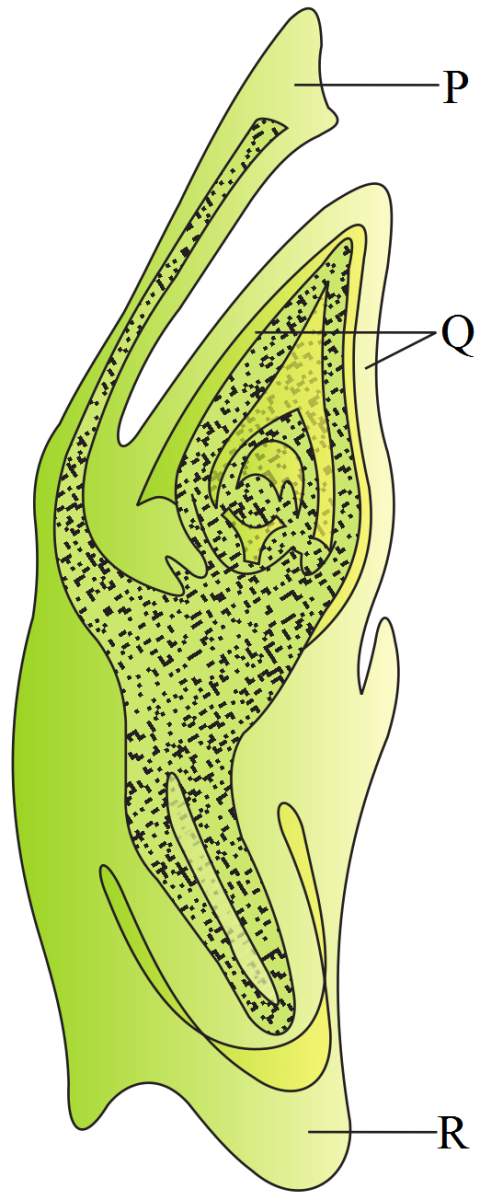
  1. Refer to the given diagram of the embryo of an angiospermous plant with parts labelled $P, Q$ and $R$. Select the correct statement$(s)$ regarding this.
  1. Part $'P\ '$ supplies nutrition to the developing embryo.
  2. Part $'Q\ '$ is the protective sheath of radicle and root cap.
  3. Part $'R\ '$ is the protective sheath of shoot apex and leaf primordia.
  4. The embryo shown in the diagram is present in members of Family Poaceae.
  1. $(IV)$ only.
  2. $(II)$ and $(III)$ only.
  3. $(I)$ and $(IV)$ only.
  4. $(I), (II), (III)$ and $(IV).$
  1. Which of the given statements are true?
  1. During the development of a dicot embryo, heart$-$shaped embryo is followed by globular embryo.
  2. The part of embryonal axis above the level of cotyledons is epicotyl, while the part below the level of cotyledons is hypocotyl.
  3. Monocot seeds possess a single cotyledon, represented by scutellum.
  1. $(I)$ and $(II).$
  2. $(II)$ and $(III).$
  3. $(I)$ and $(III).$
  4. $(I), (II)$ and $(III).$
  1. Consider the following parts of an embryonal axis of a dicot seed.
  1. Hypocotyl.
  2. Epicotyl.
  3. Radicle.
  4. Plumule.
In which of the following the above parts are correctly arranged from top to base?
  1. $(III) \rightarrow (I) \rightarrow (II) \rightarrow (IV).$
  2. $(II) \rightarrow (I) \rightarrow (III) \rightarrow (IV).$
  3. $(IV) \rightarrow (II) \rightarrow (I) \rightarrow (III).$
  4. $(III) \rightarrow (IV) \rightarrow (II) \rightarrow (I).$
  1. In grass family, the cotyledon, is called:
  1. Epiblast.
  2. Plumule.
  3. Scutellum.
  4. Perisperm.
For question two statements are given$-$one labelled Assertion and the other labelled Reason. Select the correct answer to these questions from the codes $(a), (b), (c)$ and $(d)$ as given below.
Assertion : Spleen can be thought of as an immunologic conference centre.
Reason: Spleen helps only in digestion.
For question two statements are given $-$ one labelled Assertion and the other labelled Reason. Select the correct answer to these questions from the codes $(a), (b), (c)$ and $(d)$ as given below.
Assertion : Phytoplanktons grow in abundance in the profundal zone of lake.
Reason : Profundal zone is illuminated by light which supports growth of phytoplanktons.
Bt toxin is harmful to insects like :
Directions: In the following questions, the Assertions $(A)$ and Reason$(s) (R)$ have been put forward. Read both the statements carefully and choose the correct alternative from the following:
Assertion: A bacterial cell with no restriction enzymes will be easily infected and lysed by bacteriophages.
Reason: Restriction enzymes catalyse synthesis of protective coat around bacterial cell that prevents bacteriophage attack.
Give the name of HGH (Human Growth Hormones), developed during recombinant DNA technology and used for treating hypopituitary dwarfism in human.
For question, two statements are given$-$one labelled Assertion and the other labelled Reason. Select the correct answer to these questions from the codes $(a), (b), (c)$ and $(d)$ as given below.
Assertion: Core enzyme catalyses chain elongation of $\text{RNA}.$
Reason: The presence of sigma factor is required for initiation of transcription.
Transgenic animals are extensively used for all the following procedures except :
For two statements are given$-$one labelled Assertion and the other labelled Reason. Select the correct answer to these questions from the codes $(a), (b), (c)$ and $(d)$ as given below.
Assertion: Rhythm contraceptive method can be beneficial to the couple facing fertility problem.
Reason: Rhythm method is based on the $\text{ICSI}$ technique.
For question, two statements are given$-$one labelled Assertion and the other labelled Reason. Select the correct answer to these questions from the codes $(a), (b), (c)$ and $(d)$ as given below.
 Assertion: The concept of one gene$-$one enzyme was changed to one gene$-$one polypeptide.
Reason: Each enzyme may consist of two or more different polypeptides.