Question
  1. For the complex $\ce{[Fe(H_2O)_6]^3}^+,$ write the hybridization, magnetic character and spin of the complex. $($At. number: $\ce{Fe = 26)}$
  2. Draw one of the geometrical isomers of the complex $\ce{[Pt(en)_2Cl_2]^{2+}}$ which is optically inactive.
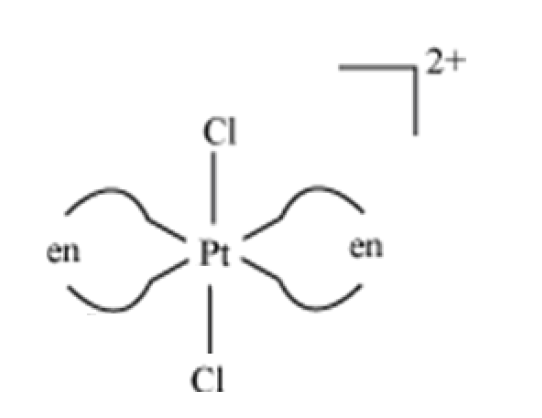
Answer

  1. $\ce{sp^{3 }d^2}$, paramagnetic, high spin.

Need a full question paper?

Generate a complete, print-ready paper with questions like this in minutes — across 16+ boards, with answer keys.

Start Generating Free

Similar questions

How many molecules of chlorine should be deposited from molten sodium chloride in one minute by a current of 300 milliampere?
Explain the following observations:
There is a close similarity in physical and chemical properties of the 4d and 5d series of the transition elements, much more than expected on the basis of usual family relationship.
Write down the $\text{IUPAC}$ name for the following complex and indicate the oxidation state, electronic configuration and coordination number. Also give stereochemistry and magnetic moment of the complex:
$\ce{K[Cr(H_2O)_2(C_2O_4)_2].3H_2O}$
A copper-silver cell is set up. The copper ion concentration in it is $0.10 M$. The concentration of silver ion is not known. The cell potential measured $0.422 V$. Determine the concentration of silver ion in the cell.
$\text{Given: E}^{o}_{\text{Ag}^{+}/\text{Ag}}=+0.80\text{V},\text{E}^{o}_{\text{Cu}^{2+}/\text{Cu}}=+0.34\text{V}.$
Write down rules to write the formulas of Mononuclear coordination entities.
Explain the following:
Haloalkanes react with KCN to form alkyl cyanides as main product while AgCN forms isocyanides as the major product.
How will you bring about the following conversions?
Iso-propyl chloride to n-propyl chloride.
Explain dehydration of alcohols with chemical equations. And also give the order for relative ease of dehydration of alcohols.
How many $mL$ of $0.1\ M\ HCl$ are required to react completely with $1\ g$ mixture of $Na_2CO_3$ and $NaHCO_3$ containing equimolar amounts of both?
Predict the products formed when cyclohexanecarbaldehyde reacts with following reagents.
$i.\ PhMgBr$ and then $H_3O^+$
$ii.$ Tollens' reagent
$iii.$ Semicarbazide and weak acid
$iv.$ Excess ethanol and acid
$v.$ Zinc amalgam and dilute hydrochloric acid