MCQ
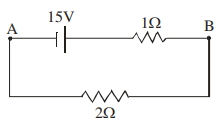
For the network shown below, the value $V _{ B }- V _{ A }$ is_______ $V$
  • A
    $9$
  • B
    $20$
  • $10$
  • D
    $30$

Answer

Correct option: C.
$10$
c
$i =\frac{15}{3}=5 \,A$

$15-5(1)=10 \,Volt$

Need a full question paper?

Generate a complete, print-ready paper with questions like this in minutes — across 16+ boards, with answer keys.
Start Generating Free

Similar questions

The mutual inductance of a pair of coils, each of $N\,turns$, is $M\,henry$. If a current of $I\, ampere$ in one of the coils is brought to zero in $t$ $second$ , the $emf$ induced per turn in the other coil, in volt, will be
The inverse square law of intensity $\Big(\text{i.e., the intensity}\propto\frac{1}{\text{r}^2}\Big)$ is valid for a:
Which among the following is the source of the magnetic field $($magnetism$)?$
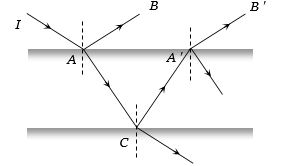
A ray of light of intensity $I$ is incident on a parallel glass-slab at a point $A$ as shown in fig. It undergoes partial reflection and refraction. At each reflection $25\%$ of incident energy is reflected. The rays $AB$ and $A'B'$ undergo interference. The ratio ${I_{\max }}/{I_{\min }}$ is
In Young's double slit experiment, the amplitudes of the two waves incident on the two slits are $A$ and $2 A$. If $I_{0}$ is the maximum intensity, then the intensity at a spot on the screen, where the phase difference between the two interfering waves is $\phi$.
In a compound microscope, if the objective produces an image $I_o$ and the eye piece produces an image $I_e$, then
In a communication system operating at wavelength $800\,nm,$ only one percent of source frequency is available as signal bandwidth. The number of channels accommodated for transmitting $TV$ signals of band width $6\,MHz$ are (Take velocity  of light $c = 3 \times 10^8\,m/s,\,\,h = 6.6 \times 10^{-34}\,J-s$ )
An electromagnetic wave going through vacuum is described by $\text{E}=\text{E}_0\sin(\text{kx}-    \omega\text{t});\text{B}=\text{B}_0\sin(\text{kx}- \omega\text{t}).$ Which of the following equation is true?
One serious drawback of semi$-$conductor devices is:
The work functions of metals $A$ and $B$ are in the ratio $1 : 2$. If light of frequencies $f$ and $2f$ are incident on the surfaces of $A$ and $B$ respectively, the ratio of the maximum kinetic energies of photoelectrons emitted is (f is greater than threshold frequency of $A, 2f$ is greater than threshold frequency of $B$)