MCQ
Force between two unit pole strength placed at a distance of one metre is
  • A
    $1 \mathrm{~N}$
  • B
    $\frac{10^{-7}}{4 \pi} \mathrm{N}$
  • $10^{-7} \mathrm{~N}$
  • D
    $4 \pi \times 10^{-7} \mathrm{~N}$

Answer

Correct option: C.
$10^{-7} \mathrm{~N}$
(c) $F=10^{-7} \times \frac{m^2}{r^2}=\frac{10^{-7}(1)^2}{(1)^2}=10^{-7} \mathrm{~N}$

Need a full question paper?

Generate a complete, print-ready paper with questions like this in minutes — across 16+ boards, with answer keys.
Start Generating Free

Similar questions

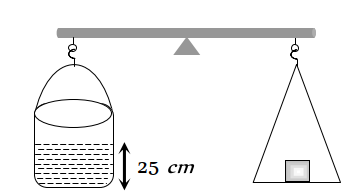
A cylinder containing water up to a height of $25 cm$ has a hole of cross-section $\frac{1}{4} cm ^2$ in its bottom. It is counterpoised in a balance. What is the initial change in the balancing weight when water begins to flow out
Image
The refractive index of the material of the prism for violet colour is $1.69$ and that for red is $1.65.$ If the refractive index for mean colour is $1.66,$ the dispersive power of the material of the prism
Intensity level of a sound of intensity $l$ is $30 \mathrm{~dB}$. The ratio $\frac{I}{I_0}$ is (Where $I_0$ is the threshold of hearing)
A sphere collides with another sphere of identical mass. After collision, the two spheres move. The collision is inelastic. Then the angle between the directions of the two spheres is
The thermal conductivity of a material in CGS system is 0.4. In steady state, the rate of flow of heat $10 \mathrm{cal} / \mathrm{sec}-\mathrm{cm}$, then the thermal gradient will be
An ideal gas expands isothermally from a volume $V_1$ to $V_2$ and then compressed to original volume $V_1$ adiabatically. Initial pressure is $P_1$ and final pressure is $P_3$. The total work done is $W$. Then
Four light waves are represented by
A cricketer hits a ball with a velocity $25 m / s$ at $60^{\circ}$ above the horizontal. How far above the ground it passes over a fielder $50 m$ from the bat (assume the ball is struck very close to the ground)
The Working of an atomizer depends upon
A particle is dropped from a height $h$. A constant horizontal velocity is given to the particle. Taking $g$ to be constant every where, kinetic energy $E$ of the particle w. r. $t$. time $t$ is correctly shown in