MCQ
The Working of an atomizer depends upon
  • Bernoulli's theorem
  • B
    Boyle's law
  • C
    Archimedes principle
  • D
    Newton's law of motion

Answer

Correct option: A.
Bernoulli's theorem
(a)

Need a full question paper?

Generate a complete, print-ready paper with questions like this in minutes — across 16+ boards, with answer keys.

Start Generating Free

Similar questions

A satellite revolves around the earth in an elliptical orbit. Its speed
$100 \mathrm{~g}$ of a iron ball having velocity $10 \mathrm{~m} / \mathrm{s}$ collides with a wall at an angle $30^{\circ}$ and rebounds with the same angle. If the period of contact between the ball and wall is 0.1 second, then the force experienced by the ball is
A long solenoid is fabricated to closely winding wire of radius $0.5\,mm$ over a cylindrical frame so that the successive turns nearly touch each other, the magnetic field at the centre of solenoid if it carries a current of $5\,A$
For total internal reflection to take place, the angle of incidence $i$ and the refractive index $\mu$ of the medium must satisfy the inequality
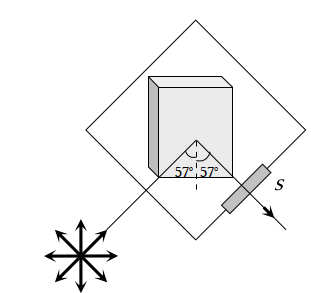
Figure represents a glass plate placed vertically on a horizontal table with a beam of unpolarised light falling on its surface at the polarising angle of 57 with the normal. The electric vector in the reflected light on screen $S$ will vibrate with respect to the plane of incidence in a

Image

Which of the following statement is wrong
When strain is produced in a body within elastic limit, its internal energy
A $50\,\Omega $ resistance is connected to a battery of $5\,V$.  A galvanometer of resistance $100\, \Omega $ is to be used as an ammeter to measure current through the resistance, for this a resistance $r_s$ is connected to the galvanometer. Which of the following connections should be employed if the measured current is within $1\% $ of the current without the ammeter in the circuit ?
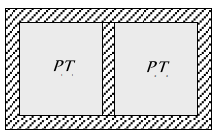
Following figure shows on adiabatic cylindrical container of volume $V_0$ divided by an adiabatic smooth piston (area of cross-section = \$ in two equal parts. An ideal gas $\left(C_P / C_V=\gamma\right)$ is at pressure $P$ and temperature $T$ in left part and gas at pressure $P$ and temperature $T$ in right part. The piston is slowly displaced and released at a position where it can stay in equilibrium. The final pressure of the two parts will be (Suppose $x=$ displacement of the piston)
Image
If $\vec{P} \cdot \vec{Q} \quad P Q$, then angle between $\vec{P}$ and $\vec{Q}$ is