MCQ
Fusion reaction takes place at high temperature because 
  • A
    nuclei break up at high temperature
  • B
    atoms get ionised at high temperature
  • kinetic energy is high enough to overcome the coulomb repulsion between nuclei
  • D
    molecules break up at high temperature
Answer

Correct option: C.
kinetic energy is high enough to overcome the coulomb repulsion between nuclei
c
Extremely high temperature needed for fusion make kinetic energy large enough to overcome coulomb repulsion between nuclei.

Need a full question paper?

Generate a complete, print-ready paper with questions like this in minutes — across 16+ boards, with answer keys.

Start Generating Free

Similar questions

Those substances whose valence band and conduction band are almost in a state of overlap are :
At room temperature $\left(27^{\circ} \mathrm{C}\right)$, the resistance of a heating element is $50 \Omega$. The temperature coefficient of the material is $2.4 \times 10^{-4}{ }^{\circ} \mathrm{C}^1$. The temperature of the element, when its resistance is $62 \Omega$, is $\qquad$ ${ }^{\circ} \mathrm{C}$.
A radioactive material undergoes decay by ejecting electrons. The electron ejected in this process is:
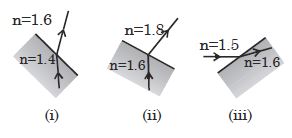
Which of the following ray diagram shows physically possible refraction ?
In Young’s double slit experiment, distance between two sources is 0.1 mm. The distance of screen from the sources is 20 cm. Wavelength of light used is 5460 Å. Then angular position of the first dark fringe is
A beam of monochromatic light is used to excite the electron in $Li ^{++}$from the first orbit to the third orbit. The wavelength of monochromatic light is found to be $x \times 10^{-10} \; m$. The value of $x$ is $\dots.$ [Given hc $=1242 \; eV nm ]$
Which one of the following represents forward bias diode?
The wavelength of light in air and some other medium are respectively ${\lambda _a}$ and ${\lambda _m}.$ The refractive index of medium is
Find the angle of deviation (given diagram)
A point object on the principal axis at a distance $15\,\, cm$ in front of a concave mirror of radius of curvature $20\,\, cm$ has velocity $2\,\, mm/s$ perpendicular to the principal axis. The velocity of image at that instant will be.......$mm/s$