Question
How an ore is concentrated by froth floatation process?
Answer

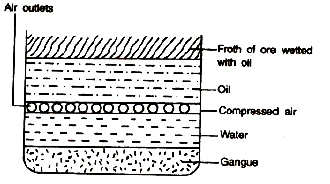
Concentrated of an ore by froth floatation process : This process depends on preferential wettability of the ore and the gangue particles. Crushed ore is taken in
a large tank containing water and certain oils. The ore particles get wetted by the oil and the gangue particles get wetted by water. The mixture is then agitated with
the help of compressed air. The ore particles that get wetted with the oil form a froth on the top, and can be scooped out. This method is used for the concentration
of sulphide ores.

Figure : Froth floatation process

Need a full question paper?

Generate a complete, print-ready paper with questions like this in minutes — across 16+ boards, with answer keys.
Start Generating Free

Similar questions

Explain the bonding in methane molecule using electron dot structure.
$(i)$ A compound has the following percentage composition by mass $: C$ is $14\%, H$ is $1.2\%$ and $Cl$ is $84.5\%$
Determine the empirical formula of this compound.
$(ii)$ The relative molecular mass of this compound is $168,$ so what is its molecular formula?
$(iii)$ By what type of reaction could this compound be obtained from ethylene?
Name the alkyl radical and the functional group of the following organic compounds:
(a) $CH_3OH$
(b) $C_2H_5OH$
(c) $C_3H_7CHO$
(d) $C_4H_9COOH$
(e) $CH_3COOH$
(f) $HCHO$
How will you distinguish between dilute $H_2SO_4$ and conc. $H_2SO_4 ?$
Making use only of substances chosen from those given below:
Dilute sulphuric acid
Sodium carbonate
Zinc
Sodium sulphite
Lead
Salcium carbonate
Give the equation for the reaction by which you could obtain:
(i) Hydrogen
(ii) Sulphur dioxide
(iii) Carbon dioxide
(iv) Zinc Carbonate (two steps required).
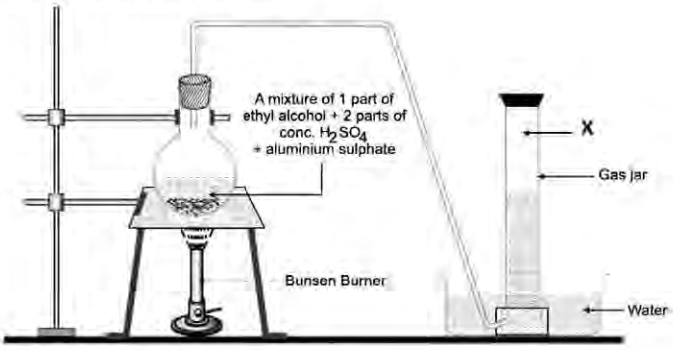
Look at the set-up of given apparatus carefully.
Image
(i) Identify 'X'.
(ii) Name the process of collection of 'X'. Justify.
(iii) Write the chemical equations involved.
(iv) What is the role of sulphuric acid in the above process?
Copy and complete the following table relating to important industrial processes output refers to the product of the process not the intermediate steps.
Name of processInputs CatalystEquation for catalysed reactionOutput
Haber processHydrogen        +
Ammonia
+
Air
Nitric acid
State differences between the properties of ionic compounds and covalent compounds.
Differentiate between the terms strong electrolyte and weak electrolyte (stating any two differences)