Question
Give the appropriate reason.
  1. It is preferable to determine the change in enthalpy rather than the change in internal energy.
  2. It is necessary to define the 'standard state'.
  3. It is necessary to specify the phases of the reactants and products in a thermochemical equation.
Answer

  1. Because it is easier to make measurement under constant pressure than under constant volume conditions.
  2. Enthalpy change depends upon the conditions in which a reaction is carried out. For making the comparison of results obtained by different people meaningful, the reaction conditions must be well-defined.
  3. Because enthalpy depends upon the phase of reactants and products.

Need a full question paper?

Generate a complete, print-ready paper with questions like this in minutes — across 16+ boards, with answer keys.

Start Generating Free

Similar questions

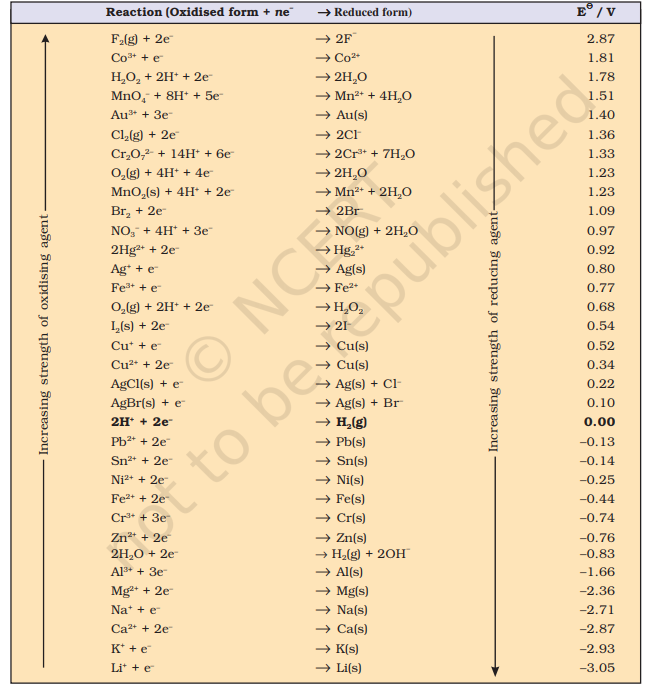
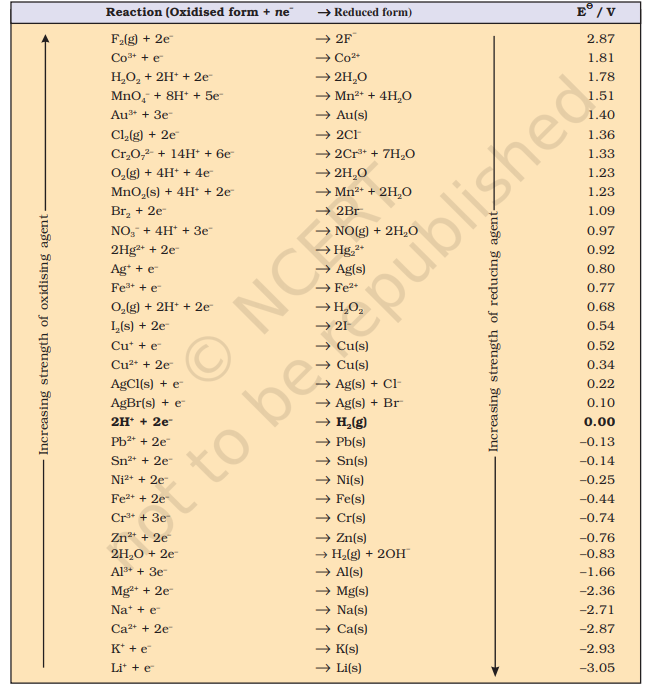
Using the standard electrode potentials given in the Table, predict if the reaction between the following is feasible:

Br2(aq) and Fe2+(aq).
The degree of ionization of a 0.1M bromoacetic acid solution is 0.132. Calculate the pH of the solution and the pKa of bromoacetic acid.
Calculate the standard Gibbs energy change for the formation of propane at 298K.

$3\text{C(graphite)}+4\text{H}_2\text{O}\overrightarrow{\ \ \ \ \ \ \ }\ \text{C}_3\text{H}_8(\text{g})$

$\Delta_\text{f}\text{H}^\circ$ for propane, C3H8(g) is -103.8kJ mol-1

Given: $\text{S}^\circ_\text{m}\text{C}_3\text{H}_8(\text{g})=270.2\text{JK}^{-1}\text{mol}^{-1},$ $\text{S}^\circ_\text{m}\text{C}_{(\text{graphite})}=5.70\text{JK}^{-1}\text{mol}^{-1}$ and $\text{S}^\circ_\text{m}\text{H}_2(\text{g})=130.7\text{JK}^{-1}\text{mol}^{-1}$

Out of electron and proton which one will have, a higher velocity to produce matter waves of the same wavelength? Explain it.
Find standard entropy change for the reaction $H _2(g)+ I _2(s) \rightarrow 2 HI ( g )$. If standard entropy of $I _2(S), H _2(g)$ and $HI ( g )$ are 116.7, 130.6 and 206.3 $JK ^{-1} mol^{-1}$ respectively. If values of $\Delta H ^{\circ}$ for this reaction is $+51.9 KJ mol ^{-1}$ then tell whether the reaction will occur spontaneously or not.
Account for the following:

  1. What is the state of hybridisation of stared carbon atoms in,

$\text{CH}_3-\text{}*\text{CH}=\text{CH}_2?$

  1. Write the molecular orbital electronic configuration of $\text{O}^-_2.$ Calculate its bond order and predict its magnetic behaviour.
Using the standard electrode potentials given in the Table, predict if the reaction between the following is feasible:

Fe3+(aq) and I-(aq).
Consider the following structure:
$\ \ \ \ \ \ \ \ \ \ \ \ \ \ \ \ \ \ \ \ \ \ \ \ \ \ \ \ \ {\text{O}}\\\ \ \ \ \ \ \ \ \ \ \ \ \ \ \ \ \ \ \ \ \ \ \ \ \ \ \ \ \ \ \|\\\ ^1\text{C}_3-\ ^2\text{CH}_2-\ ^3\text{C}-\ ^4\text{C}_2-\ ^5\text{C}\equiv\ ^6\text{CH}$
  1. How many σ and π-bonds are present in this compound?
  2. Arrange carbon no. 2, 3, 5 in decreasing order of s-character.
  3. Which atoms have same hybrid state?
An ion with mass number 37 possesses one unit of negative charge. If the ion conatins 11.1% more neutrons than the electrons, find the symbol of the ion.
For the reaction, $\text{N}_2(\text{g})+3\text{H}_2(\text{g})\rightleftharpoons2\text{NH}_3(\text{g}),$ the partial pressures of N2 and H2 are 0.80 and 0.40 atmosphere respectively at equilibrium. The total pressure of the system is 2.80 atmosphere. What is Kp for the above reaction?