MCQ
Given below are two statements :

Statement $I$ : The contact angle between a solid and a liquid is a property of the material of the solid and liquid as well.

Statement $II$ : The rise of a liquid in a capillary tube does not depend on the inner radius of the tube.

In the light of the above statements, choose the correct answer from the options given below :

  • A
    Both Statement $I$and Statement $II$ are false
  • B
    Statement $I$ is false but Statement $II$ is true.
  • Statement $I$ is true but Statement $II$ is false.
  • D
    Both Statement $I$ and Statement $II$ are true.
Answer

Correct option: C.
Statement $I$ is true but Statement $II$ is false.
c
Statement $I$ is correct as we know contact angle depends on cohesine and adhesive forces.

Statement $II$ is incorrect because height of liquid is given by $h==\frac{2 T \cos \theta_C}{\rho g r}$ where $r$ is radius of

Tube (assuming length of capillary is sufficient) Hence option $(3)$ is correct.

Need a full question paper?

Generate a complete, print-ready paper with questions like this in minutes — across 16+ boards, with answer keys.

Start Generating Free

Similar questions

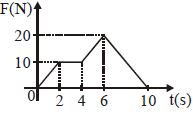
A particle of mass $2\, kg$ is initially at rest. A force acts on it whose magnitude changes  with time. The force time graph is shown below. The velocity of the particle after $10\, s$ is ......... $ms^{-1}$
If potential energy is given by $U =\frac{ a }{ r ^{2}}-\frac{ b }{ r } .$ Then find out maximum force. (Given $a =2, b =4)$
A particle moves in a region having a uniform magnetic field and a parallel, uniform electric field. At some instant, the velocity of the particle is perpendicular to the field direction. The path of the particle will be:
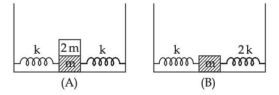
In figure $(A),$ mass ' $2 m$ ' is fixed on mass ' $m$ ' which is attached to two springs of spring constant $k$. In figure $(B),$ mass ' $m$ ' is attached to two spring of spring constant ' $k$ ' and ' $2 k$ '. If mass ' $m$ ' in $(A)$ and $(B)$ are displaced by distance ' $x$ ' horizontally and then released, then time period $T_{1}$ and $T_{2}$ corresponding to $(A)$ and $(B)$ respectively follow the relation.
The specific heat at constant volume for the monoatomic argon is $0.075\, kcal/kg-K,$ whereas its gram molecular specific heat ${C_V}$ $= 2.98\, cal/mole/K.$ The mass of the argon atom is

$(Avogadro’s \,number = 6.02 \times {10^{23}}\,molecules/mole)$

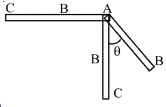
$A$ rod hinged at one end is released from the horizontal position as shown in the figure. When it becomes vertical its lower half separates without exerting any reaction at the breaking point. Then the maximum angle $‘\theta ’$ made by the hinged upper half with the vertical is ......... $^o$.
Out of following four dimensional quantities, which one quantity is to be called a dimensional constant
The dimensional formula for Boltzmann's constant is
$2\, kg$ of ice at $-20°C$ is mixed with $5\, kg$ of water at $20°C$ in an insulating vessel having a negligible heat capacity. Calculate the final mass of water remaining in the container. It is given that the specific heats of water and ice are $1\, kcal/kg\, per °C$ and $0.5\, kcal/kg/°C$ while the latent heat of fusion of ice is $80\, k\,cal/kg$ ........ $kg$
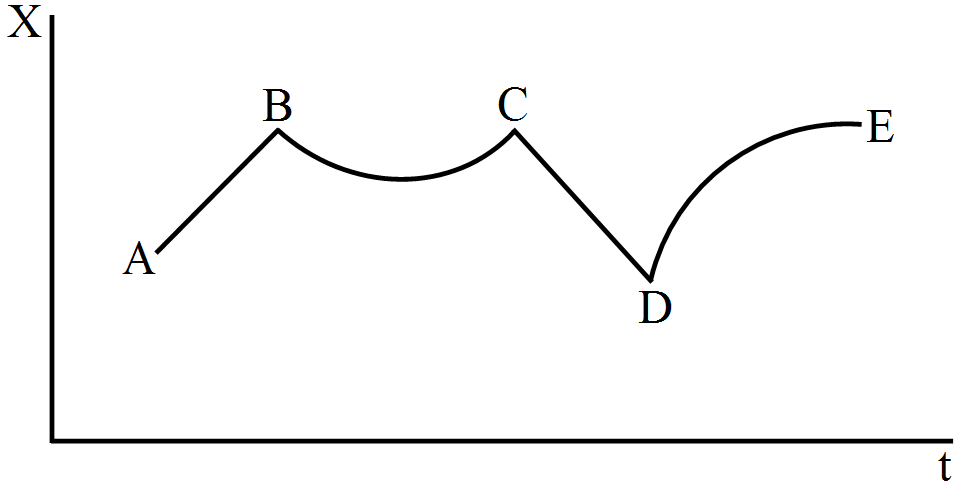
Figure shows the displacement of a particle going along the $X-$axis as a function of time. The force acting on the particle is zero in the region:
  1. $AB$
  2. $BC$
  3. $CD$
  4. $DE$