Question
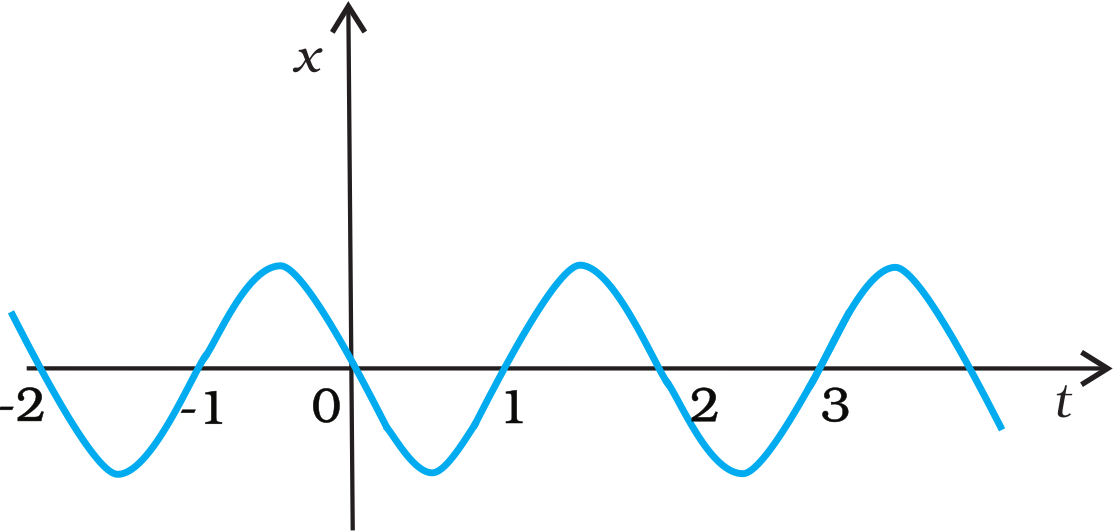
Gives the x-t plot of a particle executing one-dimensional simple harmonic motion. (You will learn about this motion in more detail in Chapter 14). Give the signs of position, velocity and acceleration variables of the particle at t = 0.3 s, 1.2 s, – 1.2 s.
Answer

For simple harmonic motion (SHM) of a particle, acceleration (a) is given by the relation:
$\text{a}=-\omega^2\text{x}$
Where $\omega$ = angular frequency
t = 0.3s
In this time interval, x is negative. Now the slope of the x-t plot is negative. Therefore, both position and velocity are negative. Acceleration of the particle using (i) will be positive.
t = 1.2s
In this time interval, x is positive. Now the slope of the x-t plot is positive. Therefore, both position and velocity are positive. Acceleration of the particle using (i) will be negative.
t = – 1.2s
In this time interval, x is negative. Now the slope of the x-t plot is positive. Therefore, position is negative and velocity is positive. Acceleration of the particle using (i) will be positive.

Need a full question paper?

Generate a complete, print-ready paper with questions like this in minutes — across 16+ boards, with answer keys.

Start Generating Free

Similar questions

A tightly-wound, long solenoid is kept with its axis parallel to a large metal sheet carrying a surface current. The surface current through a width dl of the sheet is Kdl and the number of turns per unit length of the solenoid is n. The magnetic field near the centre of the solenoid is found to be zero.
  1. Find the current in the solenoid.
  2. If the solenoid is rotated to make its axis perpendicular to the metal sheet, what would be the magnitude of the magnetic field near its centre ?
Define conservative and non-conservative forces and also describe their examples.
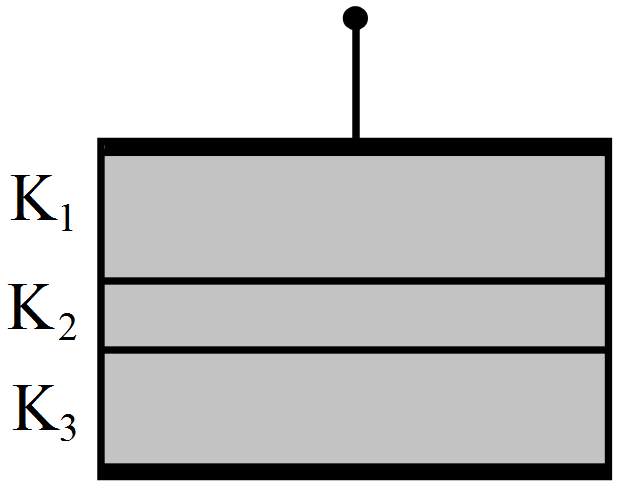
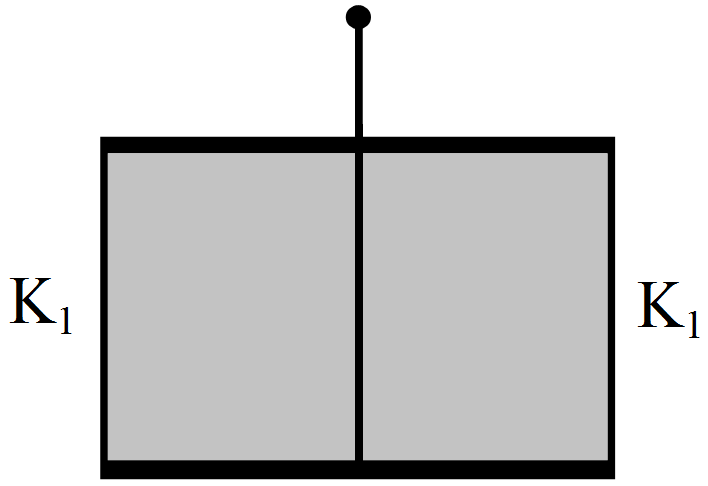
Find the capacitances of the capacitors shown in figure. The plate area is A and the separation between the plates is d. Different dielectric slabs in a particular part of the figure are of the same thickness and the entire gap between the plates is filled with the dielectric slabs.


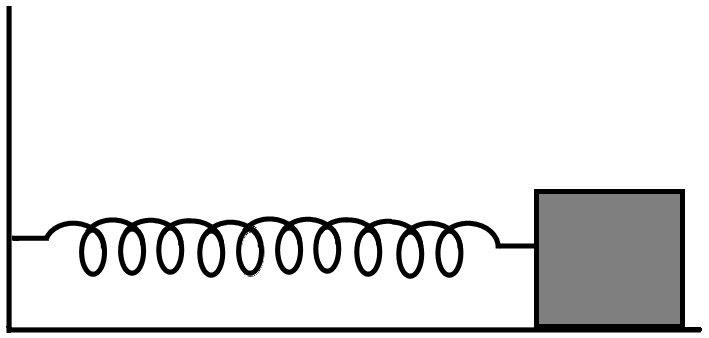
For three situations, the initial and final positions respectively, along x-axis for the block in Fig are (a) - 3cm, 2cm. (b) 2cm, 3 cm and (c) -2cm, 2cm. In each situation, is the work done by the spring force on the block positive, negative or zero?

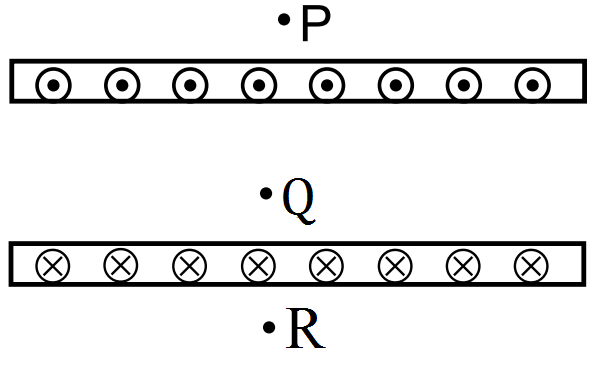
Two large metal sheets carry surface currents as shown in figure. The current through a strip of width dl is Kdl where K is a constant. Find the magnetic field at the points P, Q and R.

A solid wire of radius 10cm carries a current 5.0A distributed uniformly over its cross-section. Find the magnetic field B at a point at a distance (a) 2cm (b) 10cm and (c) 20cm away from the axis. Sketch a graph of B versus x for 0 < x < 20cm.
The electrical resistance in ohms of a certain thermometer varies with temperature according to the approximate law:
$\text{R}=\text{R}_0[1+\alpha(\text{T}-\text{T}_0)]$
The resistance is 101.6W at the triple-point of water 273.16K, and 165.5W at the normal melting point of lead (600.5K). What is the temperature when the resistance is 123.4W?
Potassium-40 can decay in three modes. It can decay by $\beta^-$-emission, $\beta^+$-emission of electron capture.
  1. Write the equations showing the end products.
  2. Find the Q-values in each of the three cases. Atomic masses of $\text{ }^{40}_{18}\text{Ar},\text{ }^{40}_{19}\text{K}$ and $\text{ }^{40}_{20}\text{Ca}$ are 39.9624u 39.9640u and 39.9626u respectively.
A brass wire 1.8m long at 27°C is held taut with little tension between two rigid supports. If the wire is cooled to a temperature of –39°C, what is the tension developed in the wire, if its diameter is 2.0mm? Co-efficient of linear expansion of brass = 2.0 × 10⁻⁵ K–1; Young’s modulus of brass = 0.91 × 10¹¹Pa.
Determine the poission's ratio of the material of wire whose volume remains constant under an external normal stress.