MCQ
Hertz experiment is used for
  • A
    Production of electromagnetic wave
  • B
    Detection of electromagnetic wave
  • Both $(a)$ and $(b)$
  • D
    None of these

Answer

Correct option: C.
Both $(a)$ and $(b)$
c
(c)

Hertz was the scientist who produced and detected the em waves.

Need a full question paper?

Generate a complete, print-ready paper with questions like this in minutes — across 16+ boards, with answer keys.
Start Generating Free

Similar questions

A coil of self-inductance $L$ is connected in series with a bulb $B$ and an $AC$ source. Brightness of the bulb decreases when
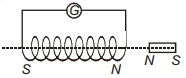
A short bar magnet passes at a steady speed right through a long solenoid. A galvanometer is connected across the solenoid. Which graph best represents the variation of the galvanometer deflection $\theta$ with time $t$ ?
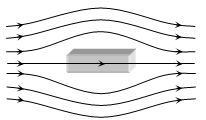
The given figure represents a material which is
A man can see upto $100 \,cm$ of the distant object. The power of the lens required to see far objects will be
Find the luminous intensity of the sun if it produces the same illuminance on the earth as produced by a bulb of $10000 \,candela$ at a distance $0.3 m.$ The distance between the sun and the earth is $1.5 \times {10^{11}}m$
Assertion : When a tiny circular obstacle is placed in the path of light from some distance, a bright spot is seen at the centre of shadow of the obstacle.
Reason : Destructive interference occurs at the centre of the shadow.
For changing the capacitance of a given parallel plate capacitor, a dielectric material of dielectric constant $K$ is used, which has the same area as the plates of the capacitor. The thickness of the dielectric slab is $\frac{3}{4} d$, where $'d'$ is the separation between the plates of parallel plate capacitor. The new capacitance $(C')$ in terms of original capacitance $\left( C _{0}\right)$ is given by the following relation
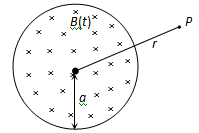
A uniform but time-varying magnetic field B(t) exists in a circular region of radius a and is directed into the plane of the paper, as shown. The magnitude of the induced electric field at point P at a distance r from the centre of the circular region

A positively charged $(+ q)$ particle of mass $m$ has kinetic energy $K$ enters vertically downward in a horizontal field of magnetic induction $\overrightarrow B $ . The acceleration of  the particle is :-
The idea of secondary wavelets for the propagation of a wave was first given by