Question
Highlight five areas where biotechnology has influenced our lives.

Answer

  1. Food Security: The earlier Green Revolution has certain limitations. Biotechnology can help in overcoming those limitations. It can help in improving the food production to meet the growing demand because of growing population. Production of Spirulina is an example which shows that huge quantity of nutrient can be produced by minimum use of land.

  2. Medicine: Many vaccines and other pharmaceuticals products have been made through biotechnology. Several diagnostic techniques; using biotechnology; has made it easier to diagnose a disease in time and has helped in better cure.

  3. Environmental Protection: Use of Bt cotton helps in minimising the use of pesticides. This is beneficial for the environment because it helps in saving useful insets.

  4. Crime Detection: DNA fingerprinting can be used to trace the identity of a criminal by using even the smallest remains of criminal’s body parts.

  5. Legal Disputes: Parentage disputes are being settled with the use of DNA fingerprinting.

Need a full question paper?

Generate a complete, print-ready paper with questions like this in minutes — across 16+ boards, with answer keys.
Start Generating Free

Similar questions

Explain packaging of DNA Helix###Explain the formation of nucleosome in Eukaryotic cell
Read the following and answer any four questions from (i) to (v) given below:
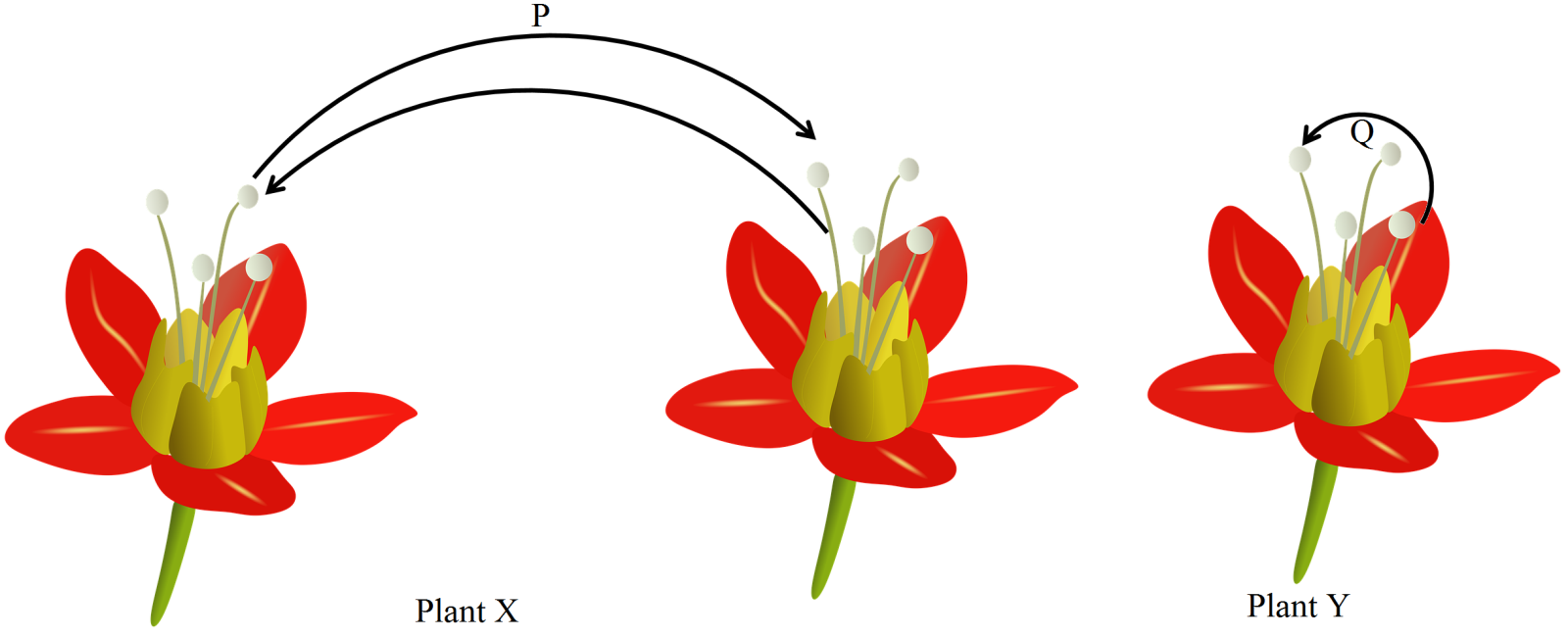
In angiosperms, the pollen grains are being transferred from the anther to the stigma and is termed pollination. This phenomenon was first discovered by Camerarius (1694) in the end of seventeenth century. Pollen grains are immobile. They cannot reach the stigma by themselves. An external agent is required for this. The pollination is mainly of two types-self pollination and cross pollination. The diagram given below shows two plants of the same species showing different types of pollination.

  1. What is transferred between the plants in the process indicated by arrow P?
  1. Ova.
  2. Pollen.
  3. Nutrients.
  4. Seeds.
  1. Which of the following statements is correct regarding processes P, Q and R?
  1. Processes P, Q and R introduce genetic variability in the offspring of sexually reproducing plants X and Y.
  2. Wind serves as agent for process Q if plants X and Y belong to Genus Salvia.
  3. Flowers of plants X and Y need to produce odour and nectar for completion of processes P and Q if they are entomophilous.
  4. If plants X and Y belong to Genus Cannabis, then their flowers need to produce sticky and heavy pollens in very small amount for accomplishment of process Q.
  1. Identify the processes P, Q and R.
S. No
P
Q
R
(a)
Geitonogamy
Xenogamy
Autogamy
(b)
Allogamy
Chasmogamy
Cleistogamy
(c)
Autogamy
Geitonogamy
Xenogamy
(d)
Geitonogamy
Allogamy
Autogamy
  1. In Catliarantl1us, the growth of style brings the stigma in contact of ripe anthers present on the mouth of corolla tube. This is an example of:
  1. Homogamy.
  2. Cleistogamy.
  3. Geitonogamy.
  4. Xenogamy.
  1. Which of the given processes represents a type of pollination that would result in greater adaptability of the particular species to potential environmental changes?
  1. P.
  2. Q.
  3. R.
  4. All of these.
Read the following and answer any four questions from (i) to (v) given below:

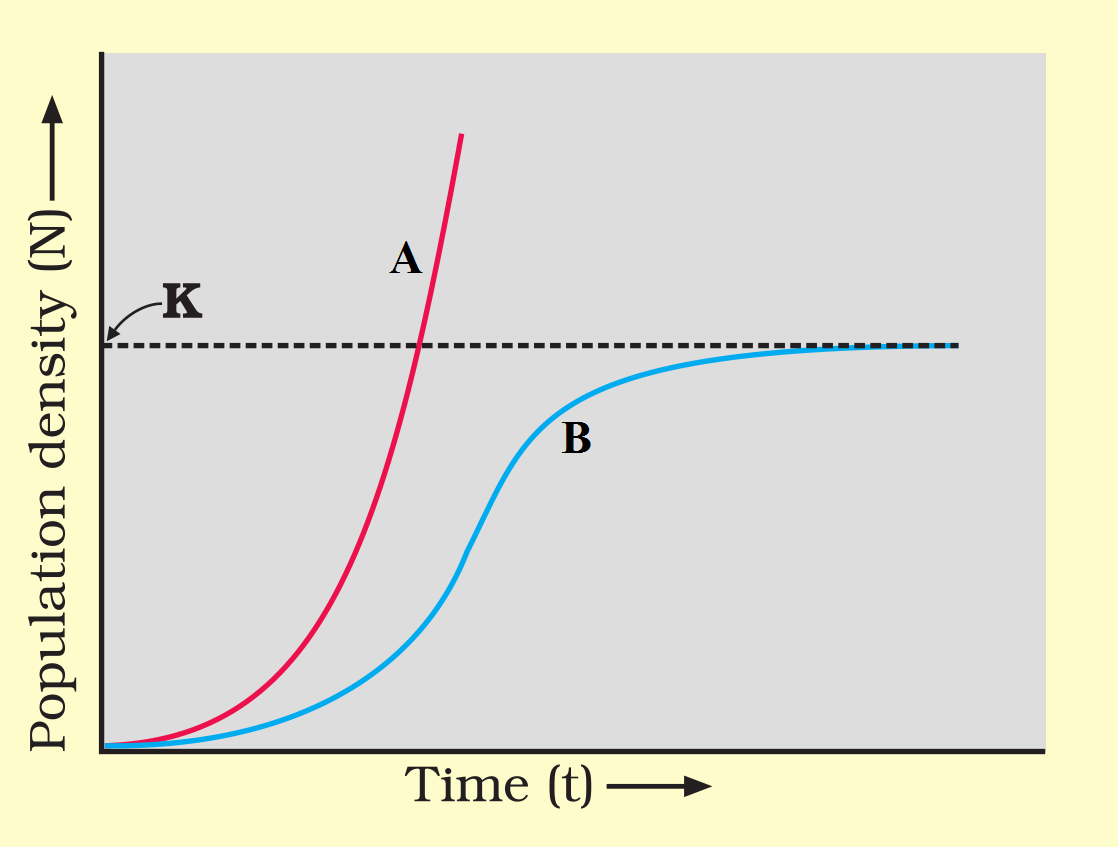
Growth of a population with time shows specific and predictable patterns. Two types of growth pattern of population are exponential and logistic growth. When resources in the habitat are unlimited each species has the ability to realise fully its innate potential to grow in number. Then the population grows in exponential fashion. When the resources are limited growth curve shows an initial slow rate and then it accelerates and finally slows giving the growth curve which is sigmoid.

  1. Which of the following statement is incorrect?
  1. Exponential growth occurs in organism such as lemmings.
  2. Logistic growth is more realistic.
  3. Exponential growth has two phases lag and log.
  4. ln logistic growth, population passes well beyond the carrying capacity of ecosystem.
  1. Which of the following equations correctly represents the exponential population growth curve?
  1. $\text{dN}/\text{dt}=\text{rN}$

  2. $\text{dN}/\text{dt}=\text{rN}\Big(\frac{\text{K-N}}{\text{K}}\Big)$

  3. $\text{N}_\text{t}=\text{N}_\text{o}\text{e}^\text{rt}$

  4. Both (a) and (c).
  1. Which of the following equations correctly represents Verhulst-Pearl logistic growth?
  1. $\text{dN}/\text{dt}=\text{rN}\Big(\frac{\text{K-N}}{\text{K}}\Big)$

  2. $\text{dN}/\text{dt}=\frac{\text{rN}}{\text{K}}$

  3. $\text{dN}/\text{dt}=\frac{\text{N}(\text{K}-\text{N})}{\text{K}}$

  4. $\text{dN}/\text{dt}=\frac{\text{r}(\text{K}-\text{N})}{\text{K}}$

  1. The population growth is generally described by the following equation:

$\frac{\text{dN}}{\text{dt}}=\text{rN}\Big(\frac{\text{K}-\text{N}}{\text{K}}\Big)$

What does 'r' represent in the given equation?
  1. Population density at time 't'.
  2. Intrinsic rate of natural increase.
  3. Carrying capacity.
  4. The base of natural logarithm.
  1. Study the population growth curves (A and B) in the given graph and select the incorrect option.

  1. Curve 'A: shows exponential growth, represented by equation $\frac{\text{dN}}{\text{dt}}=\text{rN}$.

  2. Curve 'B' shows logistic growth, represented by equation $\frac{\text{dN}}{\text{dt}}=\text{rN}\Big(\frac{\text{K}-\text{N}}{\text{K}}\Big)$

  3. Exponential growth curve is considered as more realistic than the logistic growth curve.
  4. Curve 'A' can also be represented by equation $\text{N}_\text{t}=\text{N}_\text{o}\text{e}^\text{rt}$.

Write a short note on pollination by wind.
Read the following and answer any four questions from 6(i) to 6(v) given below:

Rama lives in a society where a robbery occurred last night. Robbers came into the flat and murdered the old lady residing there. Police came and restricted the entry into the flat. They took samples from the room, where the dead body was found. While examining, they found that there is some blood and tissue in the nails of old lady. According to their observation, police filtered out their inspection to three suspects viz. servant, cook and milkman. Finally after two days of robbery, police caught the criminal. It was the old lady's cook. Rama was amazed to see that how quickly police completed and shut the case. She asked the inspector that how they did it? The police man told her that it become possible due to the sample collected from the victim, that lead them to the criminal. TI1e sample taken from nail scraping was amplified using PCR and then tested.

  1. What technique was used by the police to identify the criminal?
  1. DNA fingerprinting.
  2. Gel electrophoresis.
  3. Molecular diagnosis.
  4. Clonning.
  1. In PCR, the temperature used to denature the DNA is about:
  1. 76º
  2. 25º
  3. 95º
  4. 40º
  1. Which of the following statements regarding PCR is correct?
  1. Taq polymerase, which is isolated from bacterium Thermus aquaticus is stable at low temperature only.
  2. With the help of DNA ligase, the complementary sticky ends of the DNA are joined to produce a rDNA.
  3. Since the sequence of primers are complementary to 5' end of the template DNA, they anneal to it.
  4. DNA purified from the cell is precipitated by adding hot ethanol.
  1. Taq polymerase synthesises DNA region between the primers using:
  1. Mg2+
  2. dNTPs
  3. DNA ligase
  4. Both (a) and (b).
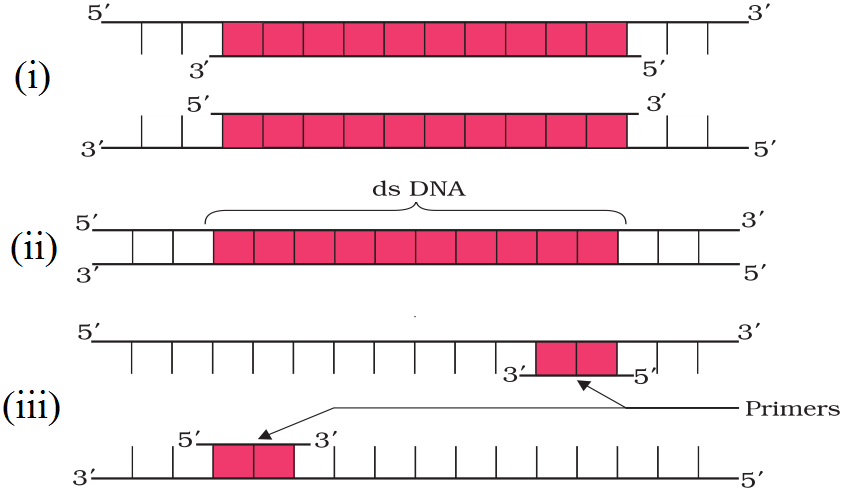
  1. Given below are steps of polymerase chain reaction.

Select the option that correctly mention the sequence in which they occur.
  1. (ii) → (iii) → (i)
  2. (i) → (ii) → (iii)
  3. (iii) → (i) → (ii)
  4. (ii) → (i) → (iii)
Read the following and answer any four questions from (i) to (v) given below:

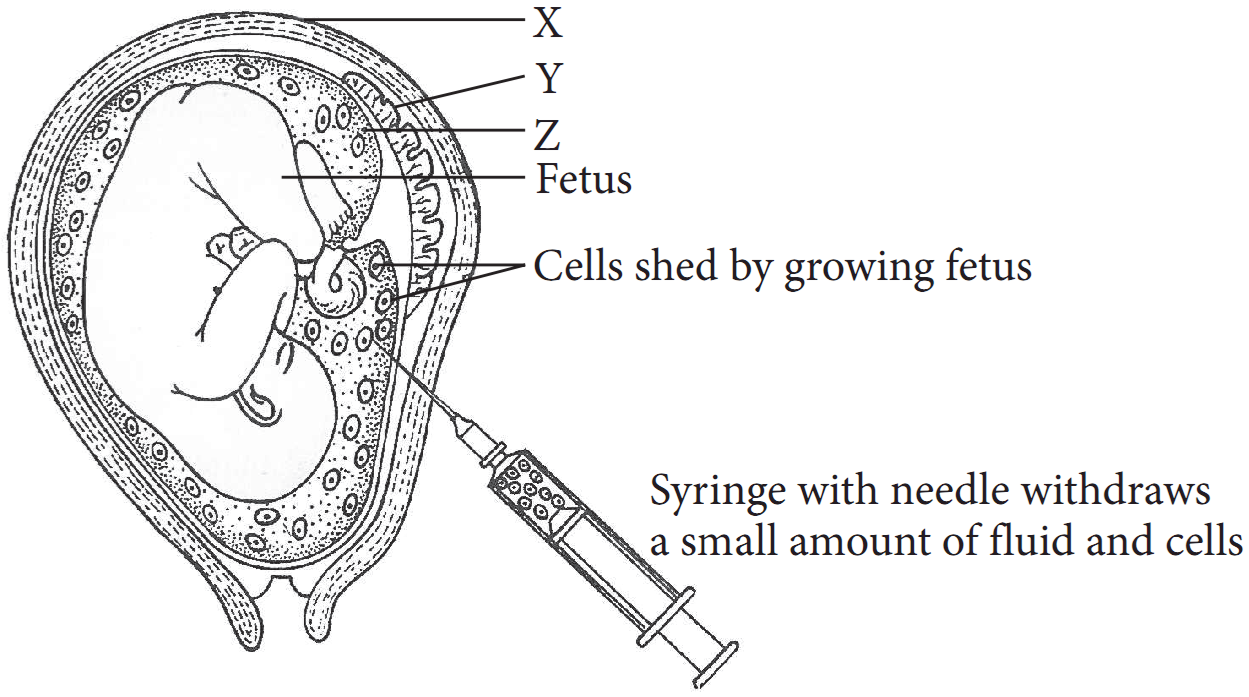
A technique known as amniocentesis is used to determine fetal abnormalities. This test chromosomal pattern in amniotic fluid. However, this technique is legally banned now.

  1. Identify X and Y in the above given figure.
S. No
X
Y
(a)
Amnion
Chorion
(b)
Uterine wall
Placenta
(c)
Placenta
Uterine wall
(d)
Uterine wall
Amnion
  1. What is the function of Z?
  1. Z is an amniotic fluid which prevents dessication of an embryo.
  2. Z is yolk sac which functions as site of early blood cell formation.
  3. Z is amnion, which takes part in placenta formation.
  4. None of these
  1. Which of the following diseases can not be diagnosed by amniocentesis?
  1. Down's syndrome.
  2. Sickle cell disease.
  3. Jaundice.
  4. Cystic fibrosis.
  1. Assertion: Amniocentesis is legally banned for sex determination.

Reason: Amniocentesis was being misused for aborting normal female fetus.
  1. Both assertion and reason are true, and reason is the correct explanation of assertion.
  2. Both assertion and reason are true, but reason is not the correct explanation of assertion.
  3. Assertion is true, but reason is false.
  4. Both assertion and reason are false.
  1. Which of these is a non-invasive technique of detecting fetal disorder?
  1. Fetoscopy.
  2. Chorionic villi sampling.
  3. Amniocentesis.
  4. Ultrasound imaging.
Read the following and answer any four questions from (i) to (v) given below:

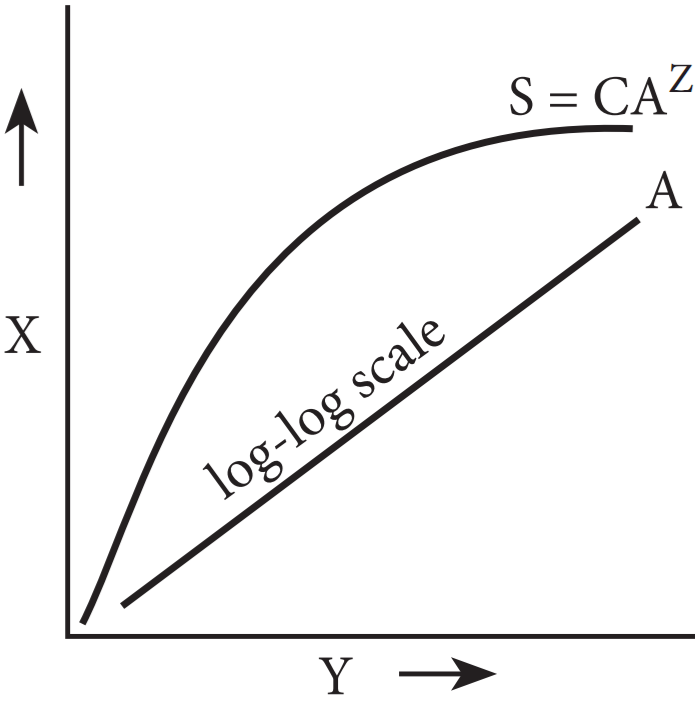
Within a region, species richness increases with increasing explored area, but only upto a limit. TI1e given graph explains this relationship.

  1. What does the given figure show?
  1. Rivet-popper hypothesis.
  2. Species-area relationship.
  3. Proportionate number of species of major taxa.
  4. $\alpha-\text{ecological diversity }$
  1. Equation for relationship (A) between species richness and area is:
  1. $\log\text{ S}=\log\text{ C}+\text{Z }\log\text{ A}$

  2. $\log\text{ C}=\log\text{ S}+\text{Z }\log\text{ A}$

  3. $\text{Z }\log\text{ A}=\log\text{ S}+\log\text{ C}$

  4. $\log\text{ S}=\log\text{ C}+\log\text{ A}$

  1. What is the value of slope of line or regression coefficient Z for frugivorous birds?
  1. 0.1 - 0.2
  2. 1.15
  3. 0.01 - 0.1
  4. 0.6 - 1.2
  1. The shape of curve for relationship between species richness and areas for wide variety of taxa is:
  1. Straight line.
  2. Parabola.
  3. Rectangular hyperbola.
  4. Bell shaped.
  1. Who gave this concept of increase in species richness with increasing offered area?
  1. Humboldt.
  2. Odum.
  3. Edward Wilson.
  4. Paul Ehrlich.
Why are vectors needed for replication of DNA during rDNA technology?
Read the following and answer any four questions from (i) to (v) given below:

Alcohols are important industrial solvents. Ethanol, methanol, propanol and butanol are produced commercially by fermentation activity of some fungi, majorly yeasts. During fermentation, yeast cells convert cereal derived sugars into ethanol and CO2 At the same time hundreds of secondary metabolites that influence the aroma and taste of alcohol are produced. Sugar concentration affects the rate of fermentation reactions. Yeast cannot grow in very strong sugar solution. In case of complex carbohydrate containing nutrient media, 1% malt or Rhizopus is used along with yeasts. Hydrolysis of starch is carried out at high temperature for 30 ruins. 'Tile crushed food mixed with hot water for obtaining malt in called mash. 'Tile nutrient medium prior to fermentation in called wort. Wort is cooled down to appropriate temperature and inoculated with strain of yeast.

  1. Tile rate of alcohol production is measured on the basis of:
  1. Amount of sugar present in the medium.
  2. Amount of CO2 produced per unit time.
  3. Amount of yeast added in the medium.
  4. All of these.
  1. A number of chemicals are produced at the time of alcoholic fermentation with the change of nutrient media, pH and aeration. Select such by-product from the following.
  1. Phenylethanol.
  2. Amyl alcohol.
  3. Glycerol.
  4. All of these.
  1. During alcoholic fermentation of cereals and potato, the crushed food mixed with hot water for obtaining malt is called:
  1. Juice.
  2. Mash.
  3. Wort.
  4. None of these.
  1. Distilled alcohol with 95% ethanol content is called:
  1. Absolute alcohol.
  2. Rectified spirit.
  3. Gin.
  4. Brandy.
  1. Assertion: Rhizopus or 1% malt is used in the nutrient medium when it contains complex carbohydrates.

Reason: Yeast does not possess sufficient diastase or amylase. 

  1. Both assertion and reason are true and reason is the correct explanation of assertion.
  2. Both assertion and reason are true but reason is not the correct explanation of assertion.
  3. Assertion is true but reason is false.
  4. Both assertion and reason are false.
Explain the methods for making host cell competent to insert the r DNA.