Question
Homogeneous mixtures are regarded as solutions or true solutions. Heterogeneous mixtures are of two types. These are suspensions and colloidal solutions. These differ in the size of the particles responsible for the difference in their properties. In a suspension, the particle size is more than $10^{-5} cm$ whereas in a colloidal solution, it ranges between $10^{-5} cm$ to $10^{-7} cm$. The two phases which constitute colloidal solutions, are dispersed phase and dispersion medium. Based upon their nature, the colloidal solutions are classified into eight types. The mixture of the non-reacting gases is always homogeneous irrespective of their nature. Therefore, it is not a colloidal solution.
i. Scattering of light occurs when a beam of light is passed through Blood. Why?
ii. What is Tyndall effect?
iii. What is called colloidal solution?
OR
Give an example of colloidal solution and identified their dispersed phase and dispersion medium?
Answer

i. Since blood is a colloid, so tyndall effect is observed when a beam of light is passed through it since the dispersed particles of a colloid are large, deflect light.
ii. The phenomenon by which the colloidal particles scatter light is called Tyndall effect. If light is passed through a colloid the light is scattered by the larger colloidal particles and the, beam becomes visible.
iii. Colloidal solutions area mixture in which the substances are regularly suspended in a fluid. A colloid is a very tiny and small material that is spread out uniformly all through another substance.
OR
Fog: Liquid (water drops) acts as dispersed phase and gas (air) as the dispersion medium.

Need a full question paper?

Generate a complete, print-ready paper with questions like this in minutes — across 16+ boards, with answer keys.

Start Generating Free

Similar questions

‘scientific’ name for organisms in the same manner that chemical symbols and formulae for various substances are used in the world. The scientific name for an organism is thus unique and can be used to identify it anywhere in the world.The system of scientific naming or nomenclature we use today was introduced by Carolus Linnaeus in the eighteenth century. The scientific name of an organism isthe process of classification which puts it along with the organisms it is most related to. But when we actually name the species, we do not list out the whole hierarchy of groups it belongs to. Instead, we limit ourselves to writing the name of the genus and species of that particular organism. World over, it has been agreed that both these names will be used in Latin forms.
Certain conventions are followed while writing the scientific names:
(1) The name of the genus begins with a capital letter.
(2) The name of the species begins with a small letter.
(3) When printed, the scientific name is given in italics.
(4) When written by hand, the genus name and the species name have to be underlined separately.
(1) The system of scientific naming or nomenclature we use today was introduced by
$(a)$ Carolus Linnaeus
$(b)$ Ernst Haeckel
$(c)$ Robert Whittaker
$(d)$ Carl Woese
(2) When scientific name is printed is given in
$(a)$ Bold
$(b)$ Italics
$(c)$ Italic in lowercase
$(d)$ Bold in uppercase
(3) Identify the correct statement
Statement $1$ – Name of the genus begins with a capital letter.
Statement $2$ – Name of the species begins with a small letter.
Statement $3$ –Name of the genus begins with a small letter
Statement $4$ –When printed, the scientific name is given in bold
$(a)$ Both $1$ & $3$
$(b)$ Both $3$ & $4$
$(c)$ Both $1$ & $2$
$(d)$ All of the above
(4) Why is there a need for systematic naming of living organisms?
(5) Which rules and conventions are need to be followed while writing the scientific names?
The individual particlesof the medium move in a direction parallel tothe direction of propagation of thedisturbance. The particles do not move fromone place to another but they simply oscillateback and forth about their position of rest.This is exactly how a sound wave propagates;hence sound waves are longitudinal waves.There is also another type of wave, calleda transverse wave. In a transverse waveparticles do not oscillate along the direction of wave propagation but oscillate up and downabout their mean position as the wave travels.Thus, a transverse wave is the one in whichthe individual particles of the medium move about their mean positions in a directionperpendicular to the direction of wavepropagation.
(i) Sound waves are
$(a)$ Transverse waves
$(b)$ Longitudinal wave
$(c)$ Both $a$ and $b$
$(d)$ None of these
(ii) Light is
$(a)$ Transverse waves
$(b)$ Longitudinal wave
$(c)$ Both $a$ and $b$
$(d)$ None of these
(iii) In case of Longitudinal waves
$(a)$ The particles do not move fromone place to another but they simply oscillateback and forth about their position of rest
$(b)$ The particles move fromone place to another
$(c)$ The particles move up and down.
$(d)$ None of these
(iv) When stone is dropped in water; waves are generated of which types?
(v) Differentiate between longitudinal wave and transverse waves.
$100 \ ml$ of water at room temperature of $25^{\circ} C$ is taken in a beaker and a little of solid $S$ is dissolved in it by stirring to obtain a solution $X$ . More and more of solid $S$ is added to the solution with constant stirring, while keeping the temperature of solution constant at $30^{\circ} C$. After some time it is observed that no more solid dissolves in water and at the same time some solid is also left undissolved at the bottom of the beaker. The contents of beaker are filtered through a filter paper to obtain solution $Y$ in the form of a filtrate.
a. What name is given to solutions like $X ?$
b. What name is given to solution like $Y ?$
c. What will you observe if the solution $Y$ at $30^{\circ} C$ is cooled down to $10^{\circ} C$ by keeping the beaker in crushed ice? Why?
d. What term is used to denote the amount of solid dissolved in $100$ grams of water in a solution like $Y ?$
A solid mixture contains four constituents $P, Q, R$ and $S. P$ consists of tiny grains and it is mixed with cement for plastering the walls. $Q$ is a white solid which is recovered on a large scale from sea water by the process of evaporation. $R$ is in the form of tiny particles of a material whose corrosion is called rusting. And $S$ is a white solid which is used in making ordinary dry cells.
  1. What could $P, Q, R$ and $S$ be?
  2. How would you separate a mixture containing $P, Q, R$ and $S?$
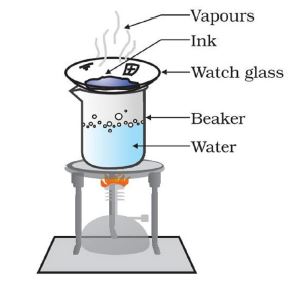
In the given below activity, on heating the solution, water evaporates, and we get back the ink dye in the watch glass. The different substance has a different boiling point. We use this property to separate the components of the mixture. Here, the boiling point of ink is much higher than that of water. On heating the ink solution, water evaporates while ink dye remains in the china dish.
$(i)$ Name the process shown in the diagram.
$(a)$ Boiling $(b)$ Filtration $(c)$ Crystallisation $(d)$ Distillation
$(ii)$ Which type of substance can be separated by this method ?
$(a)$ Any solvent from its non-volatile solute.
$(b)$ The volatile solvent from its non-volatile solute.
$(c)$ The non-volatile solvent from its non-volatile solute.
$(d)$ The volatile solvent from its volatile solute.
$(iii)$ What can we interpret about the nature of ink ?
$(a)$ We cannot separate components of ink $(b)$ Ink is not a mixture
$(c)$ Ink is pure substance $(d)$ Ink is a mixture of dyes in water.
$(iv)$ Name the component which gets evaporated.
$(a)$ Heating leads to the evaporation of water.
$(b)$ Heating leads to the evaporation of dyes.
$(c)$ Heating leads to the filtration of water.
$(d)$ Heating leads to the distillation of dyes.
$(v)$ Define the process shown in the diagram
$(a)$ It is the process of conversion of a liquid into its vapours.
$(b)$ It is a process of separating insoluble component by filtering the solution
$(c)$ It is a process that separates a pure solid in the form of its crystals
$(d)$ It is a technique to separate two miscible liquids
Newton’s first law of motion states that a body at rest will remain at rest position only and a body which is in motion continues to be in motion unless otherwise they are acted upon by an external force. In other words, all objects resist a changein their state of motion. In a qualitative way, the tendency of undisturbed objects to stayat rest or to keep moving with the same velocity is called inertia. This is why, the firstlaw of motion is also known as the law of inertia. Answer the following questions.
(i) The first law of motion is also known as
$(a)$law of inertia/p>
$(b)$law of thermodynamics
$(c)$both $a$ and $b$
$(d)$none of these
(ii) If no external force acts on object which is at rest. it will
$(a)$remain at rest
$(b)$start to move
$(c)$both a and b can possible
$(d)$none of these
(iii) If no external force acts on moving object. it will
$(a)$stop moving
$(b)$continue to move with same speed in same direction
$(c)$changes its direction of motion
$(d)$none of these
(iv) State Newton’s first law of motion.
(v) why Newton’s first law of motion is called law of inertia
There are three states of matter – solid, liquid and gas.
Solids have a definite shape, distinct boundaries and fixed volumes, that is, have negligible compressibility. Solids have a tendency to maintain their shape when subjected to outside force. Solids may break under force but it is difficult to change their shape, so they are rigid.
Liquids have no fixed shape but have a fixed volume. They take up the shape of the container in which they are kept. Liquids flow and change shape, so they are not rigid but can be called fluid.
Gas as has indefinite shape, no fixed volume. Gas gets the shape and volume of container.
Gas has very low density hence are light. Gas can flow easily and hence are called fluid.
$i.)$ Which of the following state of matter takes shape of container in which it is filled?
$a.)$ Solid
$b.)$ Liquid
$c.)$ Gas
$d.)$ Both $b$ and $c$
$ii.)$ Distance between particles of matter least in
$a.)$ Solid
$b.)$ Liquid
$c.)$ Gas
$d.)$ None of these
$iii.)$ Compressibility is least in case of
$a.)$ Solid
$b.)$ Liquid
$c.)$ Gas
$d.)$ None of these
$iv.)$ Give properties of solids.
$v.)$ Give properties of Gases.
Read the following text carefully and answer the questions that follow:
A bee colony consists of a single queen and a large number of worker bees. Drones are present in the early stages but do not occur later on. All the functions of the colony are performed by worker bees. They build the hive, collect food, feed themselves as well as the queen, store food and protect the hive. Genetically, a worker bee does not differ from a queen bee and can even become a laying worker bee, but in most species will produce only male (drone) offspring.
i. Why are drones absent in the mature bee colony?
ii. When and how are drones produced?
iii. What is bee bread?
OR
Why worker bees are females but they do not lay eggs?
Sound is produced by vibrating objects. The matter or substance through which sound is transmitted is called a medium. It can be solid, liquid or gas. Sound moves through a medium from the point of generation to the listener. When an object vibrates, it sets the particles of the medium around it vibrating. The particles do not travel all the way from the vibrating object to the ear. Sound waves are characterized by the motion of particles in the medium and are called mechanical waves.When a vibrating objectmoves forward, it pushes and compresses theair in front of it creating a region of highpressure; this region is called a compression$(C)$.When the vibrating object moves backwards,it creates a region of low pressure calledrarefaction $(R)$. Hence sound is longitudinal wave.
(i) Sound waves are
$(a)$ Mechanical waves
$(b)$ Electromagnetic wave
$(c)$ Transverse waves
$(d)$ None of these
(ii) Sound travel in medium with
$(a)$ Compression and rare fraction
$(b)$ Crest and trough
$(c)$ Both can be possible
$(d)$ None of these
(iii) Compression is the region of
$(a)$ High pressure
$(b)$ Low pressure
$(c)$ Medium pressure
$(d)$ None of these
(iv) What is sound and how is it produced?
(v) Why sound wave is called as longitudinal wave?
The sum of momentum of the two objects before collision is equal to the sum of momentum after the collision provided there is no external unbalanced force acting on them. This is known as the law of conservation of momentum. This statement can alternatively be given as the total momentum of the two objects is unchanged or conserved by the collision. Law of conservation of momentum is applicable to system of particle. Answer the following questions.
(i)Law of conservation of momentum is applicable to
$(a)$ A system of particles
$(b)$ Only for $2$ particles
$(c)$ Only for $1$ particle
$(d)$ None of the above
(ii) Law of conservation of momentum holds good provided that
$(a)$ There should be external unbalanced force acting on particles
$(b)$ There should not be any external unbalanced force acting on particles
$(c)$ No internal forces acting on particles
$(d)$ None of the above
(iii)The total momentum of the two objects when collision occurs is
$(a)$ Changed
$(b)$ Remains conserved
$(c)$ Become zero
$(d)$ None of the above
(iv) State law of conservation of momentum.
(v) If action and Reaction are equal in magnitude and opposite in direction then why they do not cancel each other?