Question
How are electro magnetic waves produced ?
Explain.

Answer

→Neither stationary charges nor charges in uniform motion (steady currents) can create electromagnetic waves.
→Because the static electric charges produce only electro static fields, while charges in uniform motion produce magnetic fields.
→As per Maxwell's theory, accelerated charges radiate electromagnetic waves.
→An oscillating charge, which is an example of an accelerating charge, produces an oscillating electric field in space, which produces an oscillating magnetic field, which in turn, is a source of oscillating electric field and so on.
→The oscillating electric and magnetic fields thus regenerate each other, as the wave propogates through the space.
→The frequency of the EM wave is equal to the frequency of oscillation of the charge.
→An electro magnetic wave propogates in space with speed of light. In an electro magnetic wave, the Electric field, Magnetic field and direction of propogation all three are mutually perpendicular.
Need a full question paper?

Generate a complete, print-ready paper with questions like this in minutes — across 16+ boards, with answer keys.

Start Generating Free

Similar questions

Write uses of X-rays.
The electric force experienced by a charge of 1.0 × 10-6C is 1.5 × 10-3N. Find the magnitude of the electric field at the position of the charge.
A negligibly small current is passed through a wire of length 15m and uniform cross-section $6.0\times10^{-7}\ \text{m}^2,$ and its resistance is measured to be $5.0\ \Omega.$ What is the resistivity of the material at the temperature of the experiment?
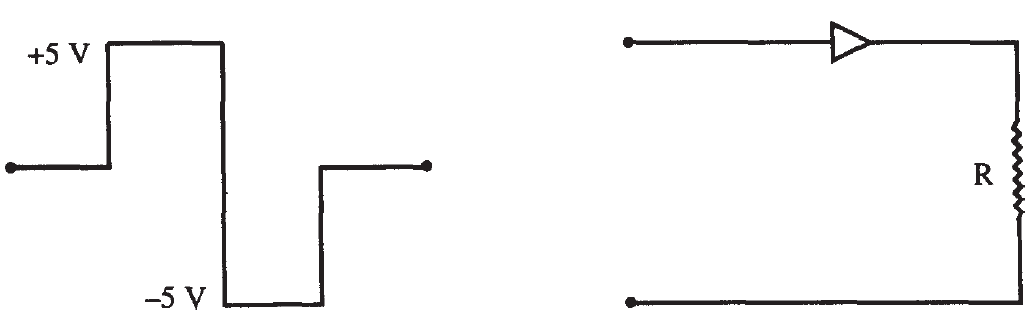
Draw and explain the output waveform across the load resistor R, if the input waveform is as shown in the given figure.

Using Rutherford model of the atom, derive the expression for the total energy of the electron in hydrogen atom. What is the significance of total negative energy possessed by the electron?
  1. State Bohr postulate of hydrogen atom that gives the relationship for the frequency of emitted photon in a transition.
  2. An electron jumps from fourth to first orbit in an atom. How many maximum number of spectral lines can be emitted by the atom? To which series these lines correspond?
It is found experimentally that $13.6 eV$ energy is required to separate a hydrogen atom into a proton and an electron. Compute the orbital radius and the velocity of the electron in a hydrogen atom.
Give brief explanation of modern solid state semi-conductor electronics.
Two uniformly large parallel thin plates having charge densities +σ and –σ are kept in the X-Z plane at a distance 'd' apart. Sketch an equipotential surface due to electric field between the plates. If a particle of mass m and charge '-q' remains stationary between the plates, what is the magnitude and direction of this field?
Distinguish between the terms 'average value' and 'rms value' of an alternating current. The instantaneous current from an a.c. source is I = 5 sin (314 t) ampere.
What are the average and rms values of the current?