MCQ
How should people wearing spectacles work with a microscope
  • A
    They cannot use the microscope at all
  • B
    They should keep on wearing their spectacles
  • C
    They should take off spectacles
  • $(b)$ and $(c) $ is both way

Answer

Correct option: D.
$(b)$ and $(c) $ is both way

Need a full question paper?

Generate a complete, print-ready paper with questions like this in minutes — across 16+ boards, with answer keys.
Start Generating Free

Similar questions

Universal time is based on
In the following list, the only pair which have different dimensions, is
A presbyopic patient has near point as $30 \mathrm{~cm}$ and far point as $40\ \mathrm{cm}$. The dioptric power for the corrective lens for seeing distant objects is
The thermo e.m.f. of a thermo-couple is $25 \mu V /{ }^{\circ} C$ at room temperature. A galvanometer of $40 ohm$ resistance, capable of detecting current as low as $10^{-5} A$, is connected with the thermocouple. The smallest temperature difference that can be detected by this system is
A galvanometer of resistance, $G,$ is shunted by a resistance $S$ $ohm$. To keep the main current in the circuit unchanged, the resistance to be put in series with the galvanometer is
Which one of the relation is correct between time period and number of orbits while an electron is revolving in a orbit
In a YDSE bi-chromatic light of wavelengths $400 nm$ and $560 nm$ are used. The distance between the slits is $0.1 mm$ and the distance between the plane of the slits and the screen is $1 m$. The minimum distance between two successive regions of complete darkness is
Two rods of same material and length have their electric resistance in ratio $1: 2$. When both rods are dipped in water, the correct statement will be
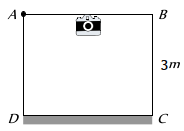
Figure shows a cubical room $A B C D$ with the wall $C D$ as a plane mirror. Each side of the room is $3 \mathrm{~m}$. We place a camera at the midpoint of the wall $A B$. At what distance should the camera be focussed to photograph an object placed at $A$

Image

When a body is thrown with a velocity $u$ making an angle $\theta$ with the horizontal plane, the maximum distance covered by it in horizontal direction is