Question
How would you distinguish among primary, secondary and tertiary alcohols?

Answer

Get the step-by-step solution for this question inside the Vidyadip app.

Get the answer in the app

Need a full question paper?

Generate a complete, print-ready paper with questions like this in minutes — across 16+ boards, with answer keys.

Start Generating Free

Similar questions

Explain the limitations of valence bound theory.
A solution containing 30 g of non-volatile solute exactly in 90 g of water has a vapour pressure of 2.8 kPa at 298 K. Further, 18 g of water is then added to the solution and the new vapour pressure becomes 2.9 kPa at 298 K. Calculate :
(i) molar mass of the solute
(ii) vapour pressure of water at 298 K
Match the catalysts given in Column $I$ with the processes given in Column $II.$
 
Column $I ($Catalyst$)$
 
Column $II ($Process$)$
$(i)$
Ni in the presence of hydrogen
$(a)$
Zieglar Natta catalyst
$(ii)$ $Cu_2Cl_2$ $(b)$
Contact process
$(iii)$ $V_2O_5$ $(c)$
Vegetable oil to ghee
$(iv)$
Finely divided iron
$(d)$
Sandmeyer reaction
$(v)$ $TiCl_4 + Al (CH_3)_3$ $(e)$
Haber’s Process
 
 
$(f)$
Decomposition of $KClO_3$
Graphically explain the effect of temperature on the rate constant of reaction. How can this temperature effect on rate constant be represented quantitatively?
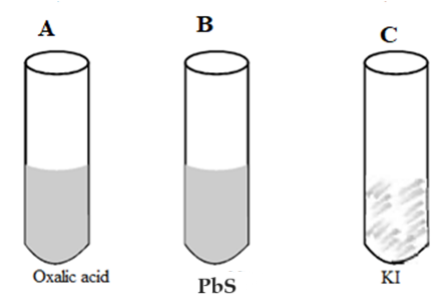
$(a).$ A purple colour compound $A,$ which is a strong oxidising agent and used for bleaching of wool, cotton, silk and other textile fibres was added to each of the three test tubes along with $H_2SO_4.$ It was followed by strong heating.
Image
In which of the above test tubes; $A, B$ or $C:$
$(i)$ Violet vapours will be formed
$(ii)$ The bubbles of gas evolved will extinguish a burning matchstick. Write an equation for each of the above observations.
$b. A$ metal ion $M^{n+}$ of the first transition series having $d^5$ configuration combines with three didentate ligands. Assuming $\Delta_0 < P:$
$(i)$ Draw the crystal field energy level diagram for the $3d$ orbital of this complex.
$(ii)$ What is the hybridisation of Mnt in this complex and why?
$(iii)$ Name the type of isomerism exhibited by this complex.

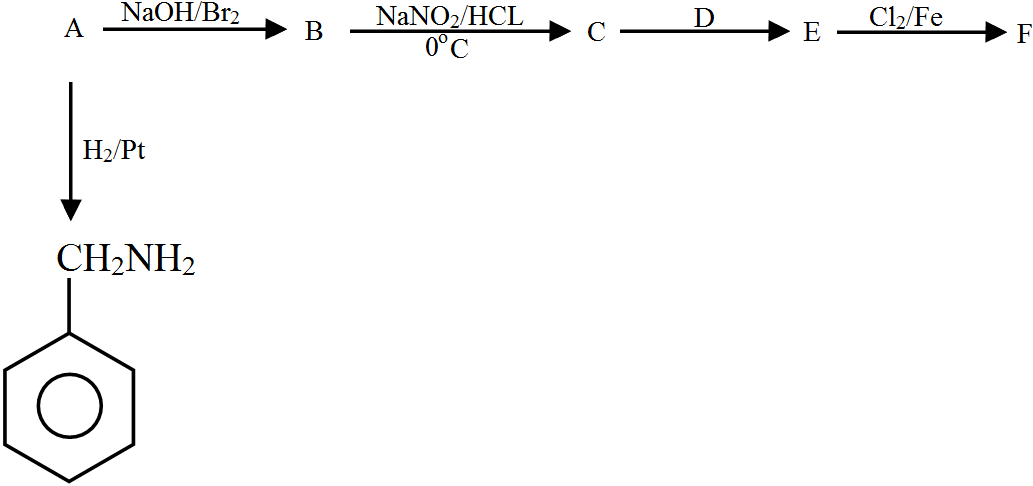
Write the structures of reagents/ organic compounds (A to F) in the following sequence of reactions:
Describe the common name system and IUPAC system of naming amines.
  1. Differentiate between molarity and molality for a solution. How does a change in temperature influence their values?
  2. Calculate the freezing point of an aqueous solution containing $10.50g$ of $\ce{MgBr_2}$ in $200 g$ of water. (Molar mass of $\ce{MgBr_2 = 184 g})$
$(K_f$​​​​​​​ for water $= 1.86 K \ kg \ mol^{–1})$
Explain fuel cell in detail and explain the shortcomings of power generation from thermal plants.