Question
$\begin{matrix}\text{A }\rightleftharpoons\text{ B }&\text{K}_1=1&\text{B }\rightleftharpoons\text{ C}&\text{K}_2=2\\\text{C }\rightleftharpoons\text{ D}&\text{K}_3=3&\text{D }\rightleftharpoons\text{ E}&\text{K}_4=4\end{matrix}$
What is value of K for $\text{A }\rightleftharpoons\text{ E}?$
Answer

$\text{A }\rightleftharpoons\text{ E K}=\frac{[\text{E}]}{[\text{A}]}$

$\text{K}_1=\frac{[\text{B}]}{[\text{A}]},\text{K}_2=\frac{[\text{C}]}{[\text{B}]},$

$\text{K}_3=\frac{[\text{D}]}{[\text{C}]}\text{ and }\text{K}_4=\frac{[\text{E}]}{[\text{D}]}$

$\because\text{K}=\text{K}_1\times\text{K}_2\times\text{K}_3\times\text{K}_4=\frac{[\text{E}]}{[\text{A}]}$

$=1\times2\times3\times4=24$

Need a full question paper?

Generate a complete, print-ready paper with questions like this in minutes — across 16+ boards, with answer keys.

Start Generating Free

Similar questions

Calculate the weight of FeO formed from 2g of VO and 5.75g of Fe2O3. Also, report the limiting reagent.
2VO + 3Fe2O3 → 6FeO + V2O5
(Atomic mass of V = 51.4, O = 16, Fe = 55.9g)
Among the elements of second period Li to Ne, pick out element:
  1. With the highest first ionisation energy.
  2. With highest electronegativity.
  3. With largest atomic radius.
  4. That is most reactive non-metal.
  5. That is most reactive metal.
  6. With valency equal to 4.
Explain the shape of BrF5.
The pH of a sample of vinegar is 3.76. Calculate the concentration of hydrogen ion in it.
How many $\sigma$ and $\sigma-$bonds are present in $\text{CH}_2=\text{C}-\text{CH}=\text{CH}_2?$
In a reaction
$A + B _2 \rightarrow AB _2$
Identify the limiting reagent, if any, in the following reaction mixtures.
(i) 300 atoms of A + 200 molecules of B
(ii) 2 mol A + 3 mol B
(iii) 100 atoms of A + 100 molecules of B
(iv) 5 mol A + 2.5 mol B
(v) 2.5 mol A + 5 mol B
Explain the following on the basis of valence bond theory:
  1. BF3 is planar but NH3 is not.
  2. CCl4 and SiCl4 are tetrahedral.
  3. The HSH bond angle is H2S is closer to 90° than HOH bond angle in H2O.
1. Use the following reactions to arrange the elements $A , B , C$ and D in order of their redox reactivity
a. $A + B ^{+} \rightarrow A ^{+}+ B$
b. $B + D ^{+} \rightarrow B ^{+}+ D$
c. $C ^{+}+ D \rightarrow$ No reaction
d. $B + C ^{+} \rightarrow B ^{+}+ C$
2. On the basis of above redox activity series, predict which of the following reactions would you expect to occur?
a. $A ^{+}+ C \rightarrow A + C ^{+}$
b. $A ^{+}+ D \rightarrow A + D ^{+}$
A box contains some identical red coloured balls, labelled as A, each weighing 2 grams. Another box contains identical blue coloured balls, labelled as B, each weighing 5 grams. Consider the combinations AB, AB2, A2B and A2B3 and show that law of multiple proportions is applicable.
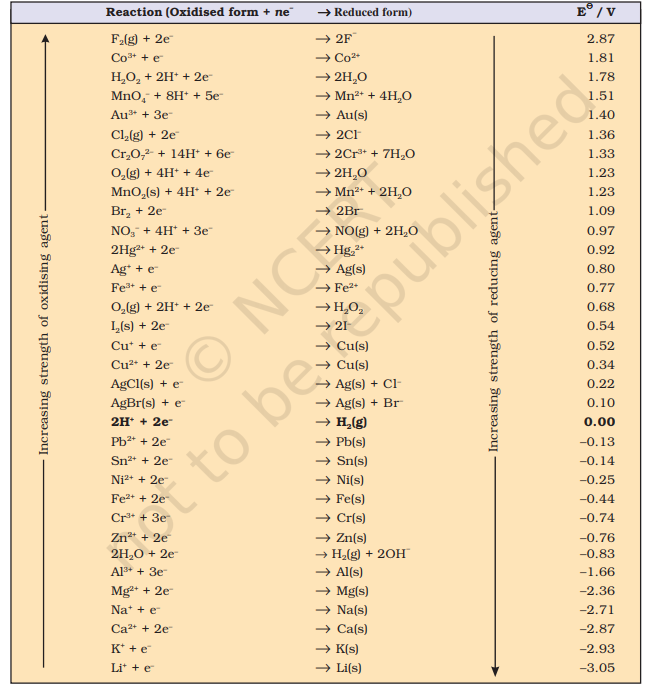
Using the standard electrode potentials given in the Table, predict if the reaction between the following is feasible:

Br2(aq) and Fe2+(aq).