Question
(i) Explain chromatic aberration for spherical lenses. State a method to minimize or eliminate it.
(ii) What is achromatism? Derive a condition to achieve achromatism for a lens combination. State the conditions for it to be converging.
Answer

(i)Lenses are prepared by using a transparent material medium having different refractive index for different colours. Hence angular dispersion is present.
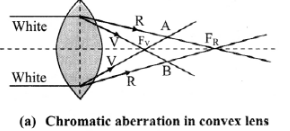
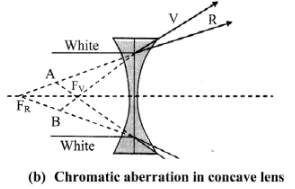
If the lens is thick, this will result into notably different foci corresponding to each colour for a polychromatic beam, like a white light. This defect is called chromatic aberration.
As violet light has maximum deviation, it is focussed closest to the pole.

Image
Image
Reducing/eliminating chromatic aberration:
  1. Eliminating chromatic aberrations for all colours is impossible. Hence, it is minimised by eliminating aberrations for extreme colours.
  2. This is achieved by using either a convex and a concave lens in contact or two thin convex lenses with proper separation. Such a combination is called achromatic combination.
    (ii)
    i. To eliminate chromatic aberrations for extreme colours from a lens, either a convex and a concave lens in contact or two thin convex lenses with proper separation are used.
    ii. This combination is called achromatic combination. The process of using this combination is termed as achromatism of a lens.
    iii. Let $ω_1$​​​​​​​ and $ω_2$​​​​​​​ be the dispersive powers of materials of the two component lenses used in contact for an achromatic combination.
    iv. Let $V, R$ and $Y$ denote the focal lengths for violet, red and yellow colours respectively.
    v. For lens $1$, let
    $K _1=\left(\frac{1}{R_1}-\frac{1}{R_2}\right)_1$ and $K _2=\left(\frac{1}{R_1}-\frac{1}{R_2}\right)_2$
    vi. For the combination to be achromatic, the resultant focal length of the combination must be the same for both the colours,
    $\therefore \quad f_V=f_R$
    $\therefore \quad \frac{1}{f_v}=\frac{1}{f_R}$
    For two thin lenses in contact, $\frac{1}{f}=\frac{1}{f_1}+\frac{1}{f_2}$
    $\therefore \quad \frac{1}{\left( f _{ v }\right)_1}+\frac{1}{\left( f _{ v }\right)_2}=\frac{1}{\left( f _{ R }\right)_1}+\frac{1}{\left( f _{ R }\right)_2}$
    vii. From Lens maker's formula,
    $ {\left[\left( n _{ V }\right)_1-1\right] K _1+\left[\left( n _{ v }\right)_2-1\right] K _2}$
    $ =\left[\left( n _{ R }\right)_1-1\right] K _1+\left[\left( n _{ R }\right)_2-1\right] K _2$
    $\therefore \quad  \frac{ K _1}{ K _2}=\frac{\left( n _{ v }\right)_2-\left( n _{ R }\right)_2}{\left( n _{ v }\right)_1-\left( n _{ R }\right)_1}$
    $\text { viii. }  \text { Similarly, for mean colour (yellow), }$
    $ \frac{1}{ f _{ r }}=\frac{1}{\left( f _{ r }\right)_1}+\frac{1}{\left( f _{ r }\right)_2}$
    $\frac{ K _1}{ K _2}=\frac{\left( n _{ Y }\right)_2-1}{\left( n _{ Y }\right)_1-1} \times \frac{\left( f _{ v }\right)_2}{\left( f _{ Y }\right)_1}$
    ix. From equations (1) and (3),
    $\frac{\left(f_{ r }\right)_2}{\left(f_{ Y }\right)_1}=-\frac{\left( n _{ V }\right)_2-\left( n _{ R }\right)_2}{\left( n _{ V }\right)_1-\left( n _{ R }\right)_1} \times \frac{\left( n _{ Y }\right)_2-1}{\left( n _{ Y }\right)_1-1}$
    Now, dispersive power $\omega_1=\frac{\left( n _{ V }\right)_2-\left( n _{ k }\right)_2}{\left( n _{ Y }\right)_2-1}$ and
    $\omega_2=\frac{\left( n _{ v }\right)_2-\left( n _{ n }\right)_2}{\left( n _{ Y }\right)_2-1}$
    x. Substituting values of $\omega_1$ and $\omega_2$ in equation (4), we get,
    $\frac{\left(f_{ Y }\right)_2}{\left(f_{ Y }\right)_1}=-\frac{\omega_2}{\omega_1}$
    This is the condition for achromatism of a combination of lenses.
    Condition for converging:
    For this combination to be converging, $fY$ must be positive.
    Using equation $(3)$, for $f_Y$​​​​​​​ to be positive, $(f_Y)_1 < (f_Y)_2 \Rightarrow ω_1 < ω_2$​​​​​​​

Need a full question paper?

Generate a complete, print-ready paper with questions like this in minutes — across 16+ boards, with answer keys.

Start Generating Free

Similar questions

If length $‘L’,$ force $‘F’$ and time $‘T’$ are taken as fundamental quantities, what would be the dimensional equation of mass and density?
Three equal charges of $10 \times 10^{-8}\ C$ respectively, each located at the corners of a right triangle whose sides are $15\ cm, 20\ cm$ and $25\ cm$ respectively. Find the force exerted on the charge located at the $90^\circ $ angle.
A metro train runs from station A to B to C. It takes 4 minutes in travelling from station A to station B. The train halts at station B for 20 s. Then it starts from station B and reaches station C in next 3 minutes. At the start, the train accelerates for 10 sec to reach the constant speed of 72 km/hr. The train moving at the constant speed is brought to rest in 10 sec. at next station.
(i) Plot the velocity- time graph for the train travelling from the station A to B to C.
(ii) Calculate the distance between the stations A, B and C.
Explain ‘mirage’ as an illustration of refraction.
Distinguish between Young’s modulus, bulk modulus and modulus of rigidity.
A letter $‘E \ ’$ is prepared from a uniform cardboard with shape and dimensions as shown in the figure. Locate its centre of mass.
Image
Explain the mechanism of forward biased p-n junction.
Explain the graph showing variation of acceleration due to gravity with altitude and depth.
Derive the expression for average acceleration and instantaneous acceleration for the motion of an object in $x-y$ plane.
A 2 m long ladder of mass 10 kg is kept against a wall such that its base is 1.2 m away from the wall. The wall is smooth but the ground is rough. Roughness of the ground is such that it offers a maximum horizontal resistive force (for sliding motion) half that of normal reaction at the point of contact. A monkey of mass 20 kg starts climbing the ladder. How far can it climb along the ladder? How much is the horizontal reaction at the wall? [Ans: 1.5 m, 15 N]