Question
$i$. Using Bohr's second postulate of quantisation of orbital angular momentum show that the circumference of the electron in the nth orbital state in hydrogen atom is $n-$ times the de $-$ Broglie wavelength associated with it.
$ii.$ The electron in hydrogen atom is initially in the third excited state. What is the maximum number of spectral lines which can be emitted when it finally moves to the ground state?
Answer

$i$. Only those orbits are stable for which the angular momentum of revolving electron is an integral multiple of $\left(\frac{h}{2 \pi}\right)$ where $h$ is the planck's constant.
According to Bohr's second postulate
$m v r_n=n \frac{h}{2 \pi} $
$\Rightarrow 2 \pi r_n=\frac{n h}{m v}$
$\text { But } \frac{h}{m v}=\frac{h}{p}=\lambda \ ($By de Broglie hypothesis$)$
$\therefore 2 \pi r_n=n \lambda$
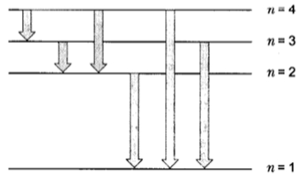
$ii$. For third excited state $ ,n = 4$
For ground state $,n = 1$
Hence possible transitions are
$ n _{ i }=4 $ to $ n _{ f }=3,2,1$
$n _{ i }=3 $  to $n _{ f }=2,1$
$n _{ i }=2 $ to $ n _{ f }=1$
Image
Total number of transitions $= 6$
$ E _C- E _{ R }=\frac{h c}{\lambda_1} \ldots( i )$
$E _{ B }- E _{ A }=\frac{h c}{\lambda_2} \ldots \text { (ii) }$
$E _{ C }- E _{ A }=\frac{h c}{\lambda_a} \ldots \text { (iii) }$
Adding $(i)$ and $(ii),$ we have
$E _{ C }- E _{ A }=\frac{h c}{\lambda_1}+\frac{h c}{\lambda_2} \ldots (iv)$
From $(iii)$ and $(iv),$ we have
$\frac{h c}{\lambda_3}=\frac{h c}{\lambda_1}+\frac{h c}{\lambda_2} $
$\Rightarrow \frac{1}{\lambda_3}=\frac{1}{\lambda_1}+\frac{1}{\lambda_2}$
$\lambda_3=\frac{\lambda_1 \lambda_2}{\lambda_1+\lambda_2}$


Need a full question paper?

Generate a complete, print-ready paper with questions like this in minutes — across 16+ boards, with answer keys.

Start Generating Free

Similar questions

A ball is given a speed v on a rough horizontal surface. The ball travels through a distance l on the surface and stops.
  1. What are the initial and final kinetic energies of the ball?
  2. What is the work done by the kinetic friction?
Consider a variation of the previous problem (figure). Suppose the circular loop lies in a vertical plane. The rod has a mass m. The rod and the loop have negligible resistances but the wire connecting O and C has a resistance R. The rod is made to rotate with a uniform angular velocity $\omega$ in the clockwise direction by applying a force at the midpoint of OA in a direction perpendicular to it. Find the magnitude of this force when the rod makes an angle $\theta$ with the vertical.
In a Geiger - Marsden experiment, calculate the distance of closest approach to the nucleus of Z = 80, when an α-particle of 8 MeV nergy impinges on it before it comes momentarily to rest and reverses its direction.
How will the distance of closest approach be affected when the kinetic energy of the α-particle is doubled?
A solid sphere rolling on a rough horizontal surface with a linear speed v collides elastically with a fixed, smooth, vertical wall. Find the speed of the sphere after it has started pure rolling in the backward direction.
A closely wound solenoid of $2000$ turns and area of cross$-$section $1.6 \times 10^{–4} m2$, carrying a current of $4.0 A,$ is suspended through its centre allowing it to turn in a horizontal plane.
  1. What is the magnetic moment associated with the solenoid?
  2. What is the force and torque on the solenoid if a uniform horizontal magnetic field of $7.5 \times 10^{–2}\ T$ is set up at an angle of $30^\circ$ with the axis of the solenoid?
Suppose a monochromatic X-ray beam of wavelength 100pm is sent through a Young's double slit and the interference pattern is observed on a photographic plate placed 40cm away from the slit. What should be the separation between the slits so that the successive maxima on the screen are separated by a distance of 0.1mm?
Find the acceleration of the moon with respect to the earth from the following data:
Distance between the earth and the moon $= 3.85 \times 10^5\ km$ and the time taken by the moon to complete one revolution around the earth $= 27.3$ days.
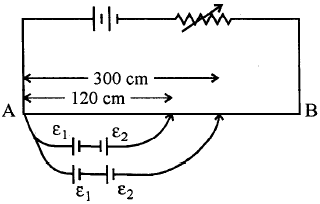
In the figure a long uniform potentiometer wire $AB$ is having a constant potential gradient along its length. The null points for the two primary cells of emfs $\varepsilon_{1}$ and $\varepsilon_{2}$
connected in the manner shown are obtained at a distance of $120 \ cm $ and $300 \ cm$ from the end $A$.
Find $(i) \varepsilon_{1} / \varepsilon_{2}$ and $(ii)$ position of null point for the cell $\varepsilon_{1}$. How is the sensitivity of a potentiometer increased?
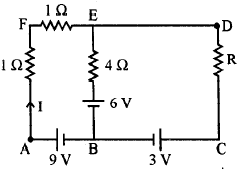
Using Kirchoffs rules determine the value of unknown resistance $R$ in the circuit so that no current flows through 4 $\Omega$ resistance. Also find the potential difference between $A$ and $D.$
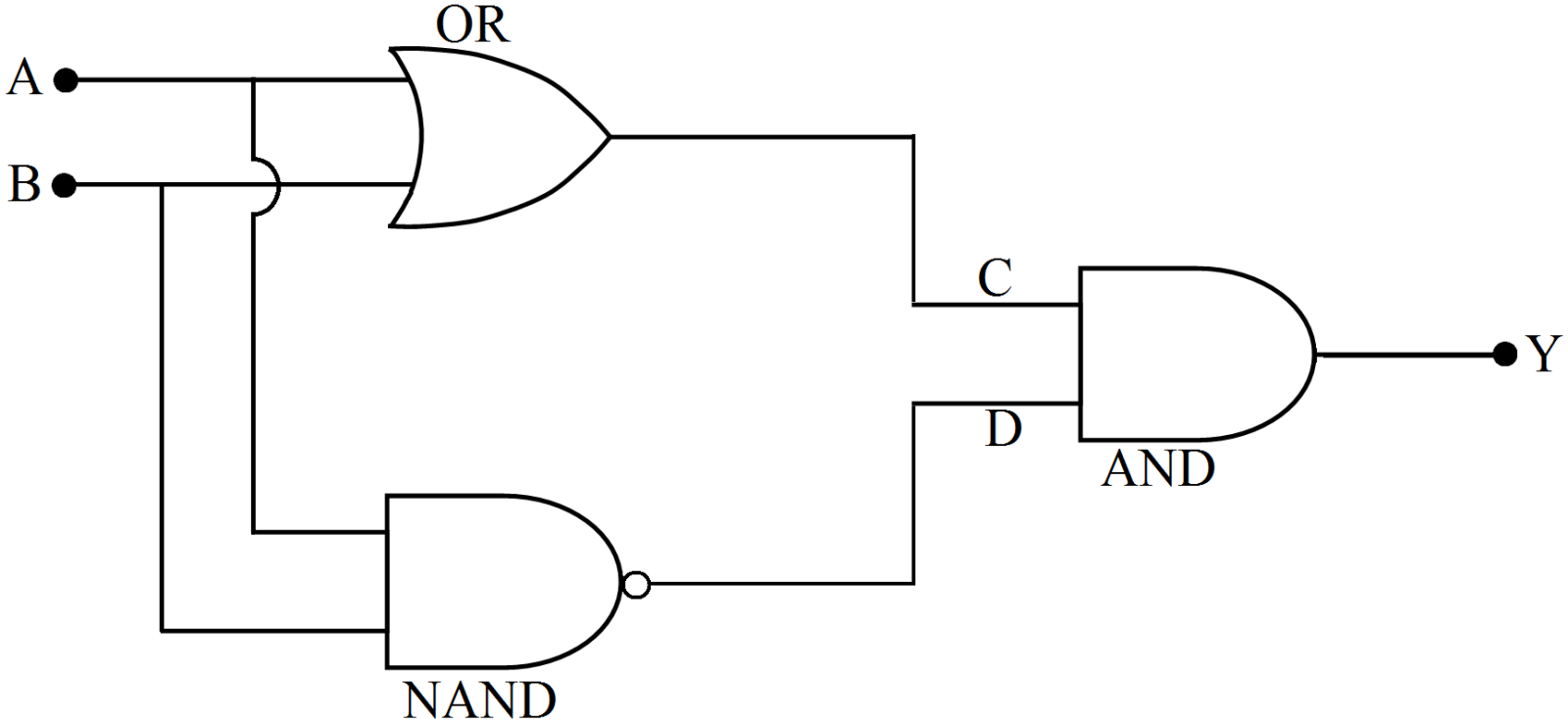
Identify the logic gate represented by the following circuit by writing its truth table:
A parallel plate capacitor with air between the plates has a capacitance of $8 pF (1pF = 10^{–12}F).$ What will be the capacitance if the distance between the plates is reduced by half, and the space between them is filled with a substance of dielectric constant $6?$