MCQ
Identify the relation between given pair
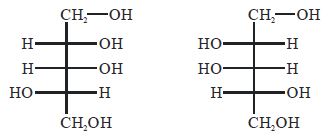
  • Enantiomer
  • B
    Diastereomers
  • C
    Epimer
  • D
    Identical

Answer

Correct option: A.
Enantiomer
a

Need a full question paper?

Generate a complete, print-ready paper with questions like this in minutes — across 16+ boards, with answer keys.
Start Generating Free

Similar questions

The process with negative entropy change is
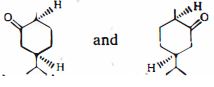
The two compounds shown below are
Benzene undergoes substitution reaction more easily than addition because:
Given below are two statements :
Statement (I) : Aqueous solution of ammonium carbonate is basic.
Statement (II) : Acidic/basic nature of salt solution of a salt of weak acid and weak base depends on $K _{ a }$ and $K _{ b }$ value of acid and the base forming it.
In the light of the above statements, choose the most appropriate answer from the options given below :
Solid $Ba(NO_3)_2$ is gradually dissolved in $1\times10^{-4}\, M\, Na_2CO_3$ solution. At what concentration of $Ba^{+2}$ the precipitation of $BaCO_3$ will start? (If $K_{sp}$ of $BaCO_3 = 5.1\times10^{-9}$)
Benzene $ + \,\begin{array}{*{20}{c}}
  {\begin{array}{*{20}{c}}
  {\,\,\,\,\,\,C{H_3}\,\,\,\,\,\,\,\,\,\,\,\,\,\,\,\,\,\,\,\,\,\,\,\,\,\,} \\ 
  {|\,\,\,\,\,\,\,\,\,\,\,\,\,\,\,\,\,\,\,\,\,\,\,\,\,} 
\end{array}\,\,\,\,} \\ 
  {C{H_3} - C - C{H_2} - Cl\xrightarrow{{AlC{l_3}}}} \\ 
  {|\,\,\,\,\,\,\,\,\,\,\,\,\,\,\,\,\,\,\,\,\,\,\,\,\,\,\,\,\,} \\ 
  {C{H_3}\,\,\,\,\,\,\,\,\,\,\,\,\,\,\,\,\,\,\,\,\,\,\,\,} 
\end{array}$  Major product
Which of these reagents would accomplish the following reduction ?

$\begin{matrix}
   O\,\,\,\,\,\,\,\,\,\,\,\,\,\,\,\, \,\, \\
   ||\,\,\,\,\,\,\,\,\,\,\,\,\,\,\,\,\,\,  \\
   N\equiv C-C{{H}_{2}}-C-C{{H}_{2}}-CH=C{{H}_{2}}\to   \\
\end{matrix}$ $\begin{matrix}
   OH\,\,\,\,\,\,\,\,\,  \\
   |\,\,\,\,\,\,\,\,\, \,\,\,\, \\
   N\equiv C-C{{H}_{2}}-\underset{H}{\mathop{C}}\,-C{{H}_{2}}-CH=C{{H}_{2}}  \\
\end{matrix}$

For the equilibrium

$SO_2Cl_2(g) \rightleftharpoons  SO_2(g) + Cl_2(g)$ , what is the temperature at which $\frac{{{K_p}(atm)}}{{{K_c}(M)\,}} = \frac{1}{3}$ ? ......$K$

In the reaction

$xBrO_3\,^-+ yCr^{+3} + zH_2O \to Br_2 + CrO_4 ^{-2} + H^+$

the coefficients $x, y, z$ are

$\mathrm{H}_2 \mathrm{~S}$ ($5$ moles) reacts completely with acidified aqueous potassium permanganate solution. In this reaction, the number of moles of water produced is $x$, and the number of moles of electrons involved is $y$. The value of $(x+y)$ is. . . . . .