Question
If A = {1, 2, 3}; B = {3, 4, 5}; C = {4, 6}, then $\text{A}\times(\text{B}\cap\text{C})=?$
Answer

  1. {(1, 4)(2, 4)(3, 4)}
Solution:
Given,
A = {1, 2, 3}
B = {3, 4, 5}
C = {4, 6}
Now, $\text{B}\cap\text{C}=\{{4\}}$
$\therefore\text{A}\times(\text{B}\cap\text{C})=\{(1,4),(2,4),(3,4)\}$

Need a full question paper?

Generate a complete, print-ready paper with questions like this in minutes — across 16+ boards, with answer keys.

Start Generating Free

Similar questions

The value of objective function is maximum under linear constraints
  1. at the centre of feasible region
  2. at (0, 0)
  3. at any vertex of feasible region
  4. the vertex which is maximum distance from (0, 0)
If a relation $R$ is defined on $A=\{1,2,3\}$, then $R$ is, where $R =\{(1,1),(2,2),(3,3),(1,2),(2,3)$, $(1,3)\}$ :
$\int\frac{\text{xdx}}{(\text{x-1)}(\text{x-2})}$ equals:
  1. $\log\begin{vmatrix}\frac{(\text{x}-1)^2}{\text{x}-2}\end{vmatrix}+\text{c}$
  2. $\log\begin{vmatrix}\frac{(\text{x}-2)^2}{\text{x}-2}\end{vmatrix}+\text{c}$
  3. $\log\begin{vmatrix}\Big(\frac{\text{x}-1}{\text{x}-2}\Big)^2\end{vmatrix}+\text{c}$
  4. $\log|(\text{x}-1)(\text{x}-2)+\text{c}$
If $\text{f}(\text{x})=\text{e}^{\text{x}}\sin\text{x}$ in $[0,\pi],$ then c in Rolle's theorem is:
  1. $\frac{\pi}{6}$
  2. $\frac{\pi}{4}$
  3. $\frac{\pi}{2}$
  4. $\frac{3\pi}{4}$
Integrating factor of the differntial equation $\cos\text{x}\frac{\text{dy}}{\text{dx}}+\text{y}\sin\text{x}=1$is:  
  1. $\sin\text{x}$
  2. $\sec\text{x}$
  3. $\tan\text{x}$
  4. $\cos\text{x}$ 
If a line makes angles of $90^{\circ}, 135^{\circ}$ and $45^{\circ}$ with the $x, y$ and $z$ axes respectively, then its direction cosines are
Evaluate: $\int \tan \ x \tan 2 x \tan \ 3 x\ d x$
Mark the correct alternative in the following question:
The probability that a person is not a swimmer is 0.3. The probability that out of 5 persons 4 are swimmers is:
  1. $\text{ }^5\text{C}_4(0.7)^4(0.3)$
  2. $\text{ }^5\text{C}_1(0.7)(0.3)^4$
  3. $\text{ }^5\text{C}_4(0.7)(0.3)^4$
  4. $(0.7)^4(0.3)$
If $\vec{a}$ is a nonzero vector of magnitude ' $a$ ' and $\lambda$ a nonzero scalar, then $\lambda \vec{a}$ is unit vector if :
Choose the correct answer from the given four options.
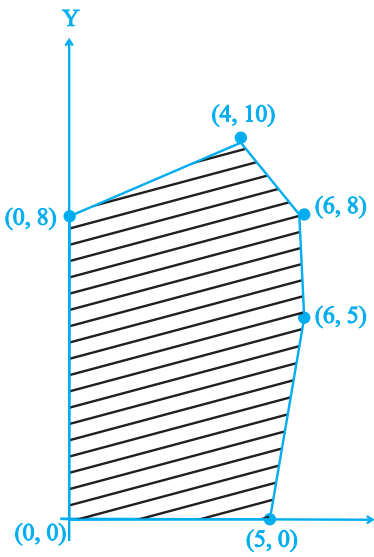
The feasible solution for a LPP is shown in. Let Z = 3x - 4y be the objective function.

Minimum of Z occurs at: