MCQ
If  $ a$  and $b$ are unit vectors such that $a \times b$ is also a unit vector, then the angle between $a$  and $ b$ is
  • A
    $0$
  • B
    $\frac{\pi }{3}$
  • $\frac{\pi }{2}$
  • D
    $\pi $

Answer

Correct option: C.
$\frac{\pi }{2}$
c
(c) $|a \times b|\, = 1 \Rightarrow \,\,|\sin \theta |\, = 1 \Rightarrow \sin \theta = 1 \Rightarrow \theta = \frac{\pi }{2}$.

Need a full question paper?

Generate a complete, print-ready paper with questions like this in minutes — across 16+ boards, with answer keys.
Start Generating Free

Similar questions

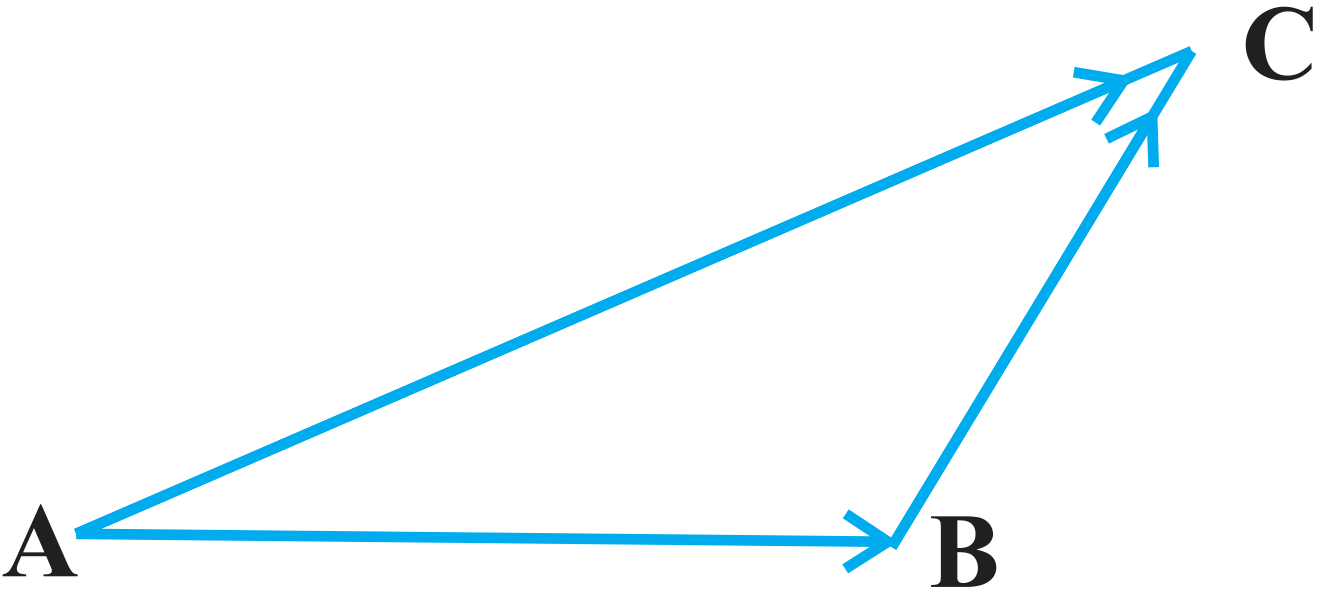
In triangle ABC (Fig 10.18), which of the following is not true:

  1. $\overrightarrow{\text{AB}}+\overrightarrow{\text{BC}}+\overrightarrow{\text{CA}}=\vec{0}$
  2. $\overrightarrow{\text{AB}}+\overrightarrow{\text{BC}}-\overrightarrow{\text{AC}}=\vec{0}$
  3. $\overrightarrow{\text{AB}}+\overrightarrow{\text{BC}}-\overrightarrow{\text{CA}}=\vec{0}$
  4. $\overrightarrow{\text{AB}}-\overrightarrow{\text{CB}}+\overrightarrow{\text{CA}}=\vec{0}$
The minimum value of Z = 4x + 3y subjected to the constraints $3\text{x}+2\text{y}\geq160,$ $5+2\text{y}\geq200,$$ 2\text{y}\geq80;\text{x},\text{y}\geq0$ is:
The area bounded by the curve y = x2 + 4x + 5, the axes of coordinates and minimum ordinate is:
  1. $3\frac{2}{3}\text{sq}.\text{ units}$
  2. $4\frac{2}{3}\text{sq}.\text{ units}$
  3. $5\frac{2}{3}\text{sq}.\text{ units}$
  4. $\text{none}\text{ of}\text{ these}$
Which of the following is not correct?
  1. $|\text{A}|=|\text{A}^{\text{T}}|,$ where $\text{A}=[\text{a}_{\text{ij}}]_{3\times3}$
  2. $|\text{kA}|=|\text{k}^3|,$ where $\text{A}=[\text{a}_{\text{ij}}]_{3\times3}$
  3. If a is a skew-symmetric of odd order, then |A| = 0
  4. $\begin{vmatrix}\text{a}&\text{c}\\\text{e}&\text{g} \end{vmatrix}+\begin{vmatrix}\text{b}&\text{c}\\\text{f}&\text{g} \end{vmatrix}+\begin{vmatrix}\text{a}&\text{d}\\\text{e}&\text{h}\end{vmatrix}+\begin{vmatrix}\text{b}&\text{d}\\\text{f}&\text{h}\end{vmatrix}$
$\int_{}^{} {\frac{{dx}}{{x[{{(\log x)}^2} + 4\log x - 1]}}} = $
$\int \limits_{-\pi}^{\pi}|\pi-| x || d x$ is equal to :
The value of $\int_1^{{e^2}} {\frac{{dx}}{{x{{(1 + \ln x)}^2}}}} $ is
$(b \times c) \times (c \times a) = $
If A is a singular matrix, then adj A is:
  1. Non-singular.
  2. Singular.
  3. Symmetric.
  4. Not defined.
The system of vectors i, j, k is:
  1. Orthogonal
  2. Collinear
  3. Coplana
  4. None of these