If a body is released into a tunnel dug across the diameter of earth, it executes simple harmonic motion with time period
Diffcult
Download our app for free and get started
Suppose a body of mass $m$ reaches at point P with depth $d$ from the surface of earth and $P$ point at distance $r$ from the centre of earth. So there is no force exerted on body of mass $m$ from external part at the distance $r$ from earth but force is exerted only by a mass of earth of radius $r$.
Acceleration due to gravity at depth $d$ from the surface of earth $g^{\prime}=g\left(1-\frac{d}{\mathrm{R}}\right)=g\left(\frac{\mathrm{R}-d}{\mathrm{R}}\right)$
Let $\mathrm{R}-d=y$,
$g^{\prime}=\frac{g y}{R}$
Force on a body of mass $m$ at point $P$,
$\mathrm{F}=-m g^{\prime}$ (force is considered negative
$\mathrm{F}=-\frac{m g}{\mathrm{R}} \cdot y \quad \ldots$ (1) toward the centre)
$\therefore \mathrm{F} \propto-y$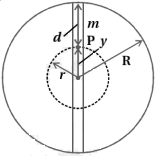

Download our appand get started for free
Experience the future of education. Simply download our apps or reach out to us for more information. Let's shape the future of learning together!No signup needed.*
Similar Questions
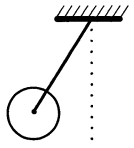
- 1A metal rod of length ' $L$ ' and mass ' $m$ ' is pivoted at one end. A thin disk of mass ' $M$ ' and radius $'R'$ $( < L)$ is attached at its center to the free end of the rod. Consider two ways the disc is attached: (case $A$) The disc is not free to rotate about its center and (case $B$) the disc is free to rotate about its center. The rod-disc system performs $SHM$ in vertical plane after being released from the same displaced position. Which of the following statement$(s)$ is (are) true? $Image$View Solution
$(A)$ Restoring torque in case $A =$ Restoring torque in case $B$
$(B)$ Restoring torque in case $A < $ Restoring torque in case $B$
$(C)$ Angular frequency for case $A > $ Angular frequency for case $B$.
$(D)$ Angular frequency for case $A < $ Angular frequency for case $B$.
- 2The potential energy of a particle $\left(U_x\right)$ executing $S.H.M$. is given byView Solution
- 3A particle executes $S.H.M.,$ the graph of velocity as a function of displacement is :-View Solution
- 4A mass $M$ is suspended from a light spring. An additional mass m added displaces the spring further by a distance $x$. Now the combined mass will oscillate on the spring with periodView Solution
- 5A particle of mass $m$ is attached to one end of a mass-less spring of force constant $k$, lying on a frictionless horizontal plane. The other end of the spring is fixed. The particle starts moving horizontally from its equilibrium position at time $t=0$ with an initial velocity $u_0$. When the speed of the particle is $0.5 u_0$, it collies elastically with a rigid wall. After this collision :View Solution
$(A)$ the speed of the particle when it returns to its equilibrium position is $u_0$.
$(B)$ the time at which the particle passes through the equilibrium position for the first time is $t=\pi \sqrt{\frac{ m }{ k }}$.
$(C)$ the time at which the maximum compression of the spring occurs is $t =\frac{4 \pi}{3} \sqrt{\frac{ m }{ k }}$.
$(D)$ the time at which the particle passes througout the equilibrium position for the second time is $t=\frac{5 \pi}{3} \sqrt{\frac{ m }{ k }}$.
- 6A simple pendulum is executing simple harmonic motion with a time period $T$. If the length of the pendulum is increased by $21\%$, the percentage increase in the time period of the pendulum of increased length is ..... $\%$View Solution
- 7The potential energy of a particle of mass $100 \,g$ moving along $x$-axis is given by $U=5 x(x-4)$, where $x$ is in metre. The period of oscillation is .................View Solution
- 8A simple pendulum, suspended from the ceiling of a stationary van, has time period $T$. If the van starts moving with a uniform velocity the period of the pendulum will beView Solution
- 9If the period of oscillation of mass $m$ suspended from a spring is $2\, sec$, then the period of mass $4m$ will be .... $\sec$View Solution
- 10For a simple pendulum the graph between $L$ and $T$ will be.View Solution