MCQ
If $a = i + j + k,\,\,b = i + j,\,\,c = i$ and $(a \times b) \times c = \lambda \,a + \mu \,b$, then $\lambda + \mu = $
  • $0$
  • B
    $1$
  • C
    $2$
  • D
    $3$

Answer

Correct option: A.
$0$
a
(a) $a\,.\,c = 1$ and $b\,.\,c = 1$

Given that $(a \times b) \times c = (c\,.\,a)b - (c\,.\,b)\,a = \mu \,b + \lambda a$

where $\mu = c\,.\,a = 1,\,\,\lambda = - \,(c\,.\,b) = - \,1$

$ \Rightarrow \,\,\mu + \lambda = 1 - 1 = 0$.

Need a full question paper?

Generate a complete, print-ready paper with questions like this in minutes — across 16+ boards, with answer keys.
Start Generating Free

Similar questions

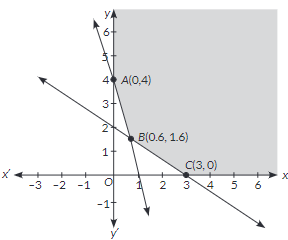
The corner points of the shaded unbounded feasible region of an LPP are $(0,4),(0.6,1.6)$ and $(3,0)$ as shown in the figure. The minimum value of the objective function $Z=4 x+6 y$ occurs at
Image
The orthogonal projection of $\vec{\text{a}}$ on $\vec{\text{b}}$ is:
  1. $\frac{\big(\vec{\text{a}}.\vec{\text{b}}\big)\vec{\text{a}}}{|\vec{\text{a}}|^2}$
  2. $\frac{\big(\vec{\text{a}}.\vec{\text{b}}\big)\vec{\text{b}}}{\big|\vec{\text{b}}\big|^2}$
  3. $\frac{\vec{\text{a}}}{|\vec{\text{a}}|}$
  4. $\frac{\vec{\text{b}}}{\big|\vec{\text{b}}\big|}$
Let ${\Delta _1} = \left| {\,\begin{array}{*{20}{c}}{{a_1}}&{{b_1}}&{{c_1}}\\{{a_2}}&{{b_2}}&{{c_2}}\\{{a_3}}&{{b_3}}&{{c_3}}\end{array}\,} \right|$ and ${\Delta _2} = \left| {\,\begin{array}{*{20}{c}}{{\alpha _1}}&{{\beta _1}}&{{\gamma _1}}\\{{\alpha _2}}&{{\beta _2}}&{{\gamma _2}}\\{{\alpha _3}}&{{\beta _3}}&{{\gamma _3}}\end{array}\,} \right|$, then ${\Delta _1} \times {\Delta _2}$ can be expressed as the sum of how many determinants
The mean and variance of a random variable $X$ having a binomial distribution are $4$ and $2$ respectively, then $P(X = 1)$ is
$\int\limits^\frac{\pi}{2}_{-\frac{\pi}{2}}\sin|\text{x}|\text{dx}$ is equal to:
  1. 1
  2. 2
  3. -1
  4. -2
If ${\tan ^{ - 1}}\frac{{x - 1}}{{x + 1}} + {\tan ^{ - 1}}\frac{{2x - 1}}{{2x + 1}} = {\tan ^{ - 1}}\frac{{23}}{{36}},$ then $ x =$
${d \over {dx}}\left[ {\log \sqrt {{{1 - \cos x} \over {1 + \cos x}}} } \right] = $
The projection of the vector $\hat{\text{i}}+\hat{\text{j}}+\hat{\text{k}}$ along the vector of $\hat{\text{j}}$ is:
  1. 1
  2. 0
  3. 2
  4. -1
  5. -2
If $\frac{\text{dy}}{\text{dx}}=3$ then y is equal to:
  1. 3x
  2. 0
  3. 3x + c
  4. $\frac{\text{x}}{3}+\text{c}$
If the vector $\vec a=i-j+2k ,\vec b=2i+4j+k $ and $\vec c=$ $\alpha i+j+\beta k$  are mutually orthogonal then $(\alpha ,\beta ) =$