Question
If a LC circuit is considered analogous to a harmonically oscillating spring block system, which energy of the LC circuit would be analogous to potential energy and which one analogous to kinetic energy?
Answer


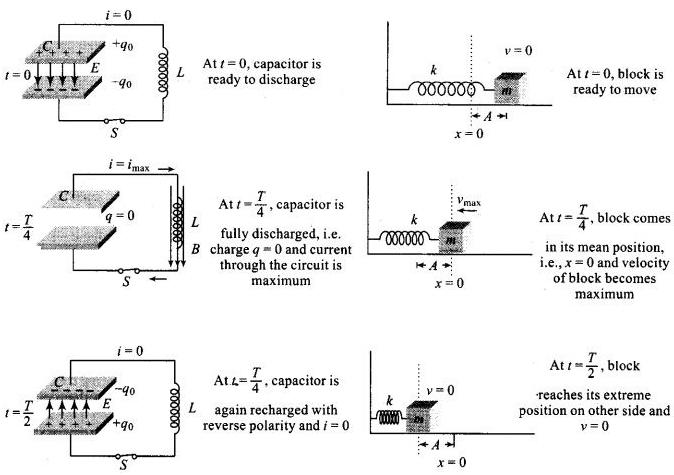
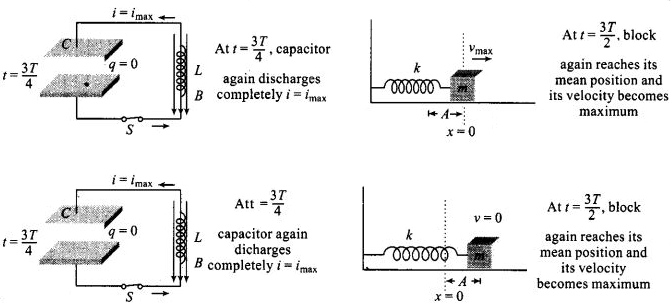
When a charged capacitor C having an initial charge $q_0$ is discharged through an inductance L, the charge and current in the circuit start oscillating simple harmonically. If the resistance of the circuit is zero, no energy is dissipated as heat. We also assume an idealized situation in which energy is not radiated away from the circuit. The total energy associated with the circuit is constant.
The oscillation of the LC circuit are an electromagnetic analog to the mechanical oscillation of a block-spring system.
The total energy of the system remains conserved.
$\frac{1}{2}\text{CV}^2+\frac{1}{2}\text{LI}^2=\text{Constant}=\frac{1}{2}\text{CV}^2_0=\frac{1}{2}\text{LI}^2_0$

Mass spring systerm
v/s
LC circuit
Displacement (x)
 
Charge (q)
Velocity (v)
 
Current (i)
Acceleration (a)
 
Rate of change of current $\Big(\frac{\text{di}}{\text{dt}}\Big)$
Mass (m) [Inertia]
 
Inductance (L) [Inertia of electricity]
Momentum (p = mv)
 
Magnetic flux $(\phi=\text{Li})$
Retarding force $\Big(-\text{m}\frac{\text{dv}}{\text{dt}}\Big)$
 
Self induced emf $\Big(-\text{L}\frac{\text{di}}{\text{dt}}\Big)$
Equation of free oscillations:
$\frac{\text{d}^2\text{x}}{\text{dt}^2}=-\omega^2\text{x};$
where $\omega=\sqrt{\frac{\text{K}}{\text{m}}}$
 
Equation of free oscillations:
$\frac{\text{d}^2\text{q}}{\text{dt}^2}=-\Big(\frac{1}{\text{LC}}\Big).\text{q};\text{where }\omega^2=\frac{1}{\text{LC}}$
$\Rightarrow\ \omega=\frac{1}{\sqrt{\text{LC}}}$
Force constant K
 
Capacitance C
Kinetic energy $=\frac{1}{2}\text{mv}^2$
 
Magnetic energy $=\frac{1}{2}\text{Li}^2$
Elastic potential energy $=\frac{1}{2}\text{Kx}^2$
 
Elecrical potential energy $=\frac{1}{2}\frac{\text{q}^2}{\text{C}}$
If we consider an L-C circuit analogous to a harmonically oscillating spring block system. The electrostatic energy $\frac{1}{2}\text{CV}^2$ is analogous to potential energy and energy associated with moving charges (current) that is magnetic energy $\Big(\frac{1}{2}\text{LI}^2\Big)$ is analogous to kinetic energy.

Need a full question paper?

Generate a complete, print-ready paper with questions like this in minutes — across 16+ boards, with answer keys.
Start Generating Free

Similar questions

50cal of heat should be supplied to take a system from the state A to the state B through the path ACB as shown in figure. Find the quantity of heat to be supplied to take it from A to B via ADB.
A body of weight $w_1$ is suspended from the ceiling of a room through a chain of weight $w_2$. The ceiling pulls the chain by a force:
What are N-type semiconductors? Their conductivity is higher than that of pure semiconductors. Why? Explain with figure.
An electron emitted by a heated cathode and accelerated through a potential difference of 2.0 kV, enters a region with uniform magnetic field of 0.15 T. Determine the trajectory of the electron if the field,
  1. is transverse to its initial velocity,
  2. makes an angle of 30º with the initial velocity.
  1. Using Biot-Savart’s law, derive an expression for the magnetic field at the centre of a circular coil of radius R, number of turns N, carrying current i.
  2. Two small identical circular coils marked 1, 2 carry equal currents and are placed with their geometric axes perpendicular to each other as shown in the figure. Derive an expression for the resultant magnetic field at O.
A particle A having a charge of $2.0 \times 10^{-6}C$ is held fixed on a horizontal table. A second charged particle of mass 80g stays in equilibrium on the table at a distance of 10cm from the first charge. The coefficient of friction between the table and this second particle is $\mu=0.2.$ Find the range within which the charge of this second particle may lie.
A particle of mass m and charge q is released from the origin in a region in which the electric field and magnetic field are given by
$\overrightarrow{\text{B}}=-\text{B}_0\overrightarrow{\text{j}}$ and $\overrightarrow{\text{E}}=\text{E}_0\overrightarrow{\text{k}}.$ Find the speed of the particle as a function of its z-coordinate.
A 50-turn circular coil of radius 2.0cm carrying a current of 5.0A is rotated in a magnetic field of strength 0.20T.
  1. What is the maximum torque that acts on the coil?
  2. In a particular position of the coil, the torque acting on it is half of this maximum. What is the angle between the magnetic field and the plane of the coil?
A capacitor is made of a flat plate of area A and a second plate having a stair-like structure as shown in figure. The width of each stair is a and the height is b. Find the capacitance of the assembly.
Figure shows an outline of Lloyd's mirror experiment. $M$ is a plane mirror; $S$ is a narrow slit illuminated by some source of light $($not shown$)$ and $S$' is the image of S in $M. M, S$ and $S$' are in a plane perpendicular to the paper. $O$ is the line of intersection of the mirror and the screen.
$a.$ What is the origin of fringes observed on the screen? 
Image

$b$. Why is the slit S placed so as to have very oblique angle of incidence of light striking the mirror?
$c.$ The two path lengths $PS$ and $PS$' are equal when $P$ coincides with $O$. Yet the fringe at $O$ is found in the experiment to be dark not bright. What does this observation imply?