MCQ
If a particle is moving on a circular path with constant speed, then the angle between the direction of acceleration and its position vector w.r.t. centre of circle will be ............ 
  • $\pi$
  • B
    $\frac{\pi}{2}$
  • C
    Zero
  • D
    $2 \pi$

Answer

Correct option: A.
$\pi$
a
(a)

Direction of Velocity is tangential to the circular path at any instance. At the very same instance, acceleration is along the radius, directed towards centre. So the angle between the direction of acceleration and its position vector with respect to the centre of the circle will be $\pi$ or $180^{\circ}$.

Need a full question paper?

Generate a complete, print-ready paper with questions like this in minutes — across 16+ boards, with answer keys.
Start Generating Free

Similar questions

A system of particles is called a rigid body when:
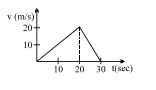
$v-t$ graph of an object of mass $1\,\, kg$ is shown
Dimensional formula of resistivity is
Two trains travelling on the same track are approaching each other with equal speeds of $40\ m/s$ . The drivers of the trains begin to decelerate simultaneously when they are just $2.0\ km$ apart. Assuming the decelerations to be uniform and equal, the value of the deceleration to barely avoid collision should be..........$m/s^2$
Which of the following is incorrect about strong nuclear force?
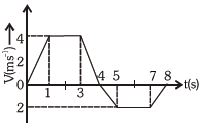
The $v -t$ graph of a rectilinear motion is shown in adjoining figure. The distance from  starting point after $8$ seconds is ..........$metre$
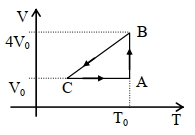
One mole of an ideal gas in initial state $\mathrm{A}$ undergoes a cyclic process $A B C A$, as shown in the figure. Its pressure at $A$ is $\mathrm{P}_0$. Choose the correct option$(s)$ from the following

$(A)$ Internal energies at $\mathrm{A}$ and $\mathrm{B}$ are the same

$(B)$ Work done by the gas in process $\mathrm{AB}$ is $\mathrm{P}_0 \mathrm{~V}_0 \ln 4$

$(C)$ Pressure at $C$ is $\frac{P_0}{4}$

$(D)$ Temperature at $\mathrm{C}$ is $\frac{\mathrm{T}_0}{4}$
The coordinates of a particle moving in a plane are given by $x = a\cos (pt)$ and $y(t) = b\sin (pt)$ where $a,\,\,b\,( < a)$ and $p$ are positive constants of appropriate dimensions. Then
For a body moving in a circular path, a condition for no skidding if $\mu $ is the coefficient of friction, is
One mole of an ideal monatomic gas requires $210 \,J$ heat to raise the temperature by $10\, K$, when heated at constant temperature. If the same gas is heated at constant volume to raise the temperature by $10\, K$ then heat required is  ....... $J$