If all the resistors shown have the value $2\, ohm$ each, the equivalent resistance over $AB$ is
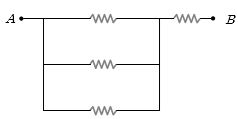
Easy


Download our appand get started for free
Experience the future of education. Simply download our apps or reach out to us for more information. Let's shape the future of learning together!No signup needed.*
Similar Questions
- 1View SolutionThe material of fuse wire should have
- 2A copper wire of diameter $1.02\, mm$ carries a current of $1.7\, amp$. Find the drift velocity $(v_d)$ of electrons in the wire. Given $n$, number density of electrons in copper $= 8.5 \times 10^{27} /m^3$....................... $mm/sec$View Solution
- 3Two resistance wires on joining in parallel the resultant resistance is $\frac{6}{5}\,ohms$. One of the wire breaks, the effective resistance is $2\,ohms$. The resistance of the broken wire is ............ $ohm$View Solution
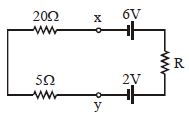
- 4The current flowing in the given circuit is $0.1\,A$ . The potential difference between the points $X$ and $Y$ is ................ $\mathrm{V}$View Solution
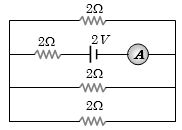
- 5View SolutionThe reading of the ammeter as per figure shown is
- 6View SolutionWatt-hour meter measures
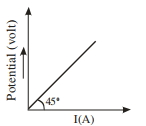
- 7The variation of applied potential and current flowing through a given wire is shown in figure. The length of wire is $31.4 \,cm$. The diameter of wire is measured as $2.4 \,cm$. The resistivity of the given wire is measured as $x \times 10^{-3} \,\Omega cm$. The value of $x$ is_______ [Take $\pi=3.14]$View Solution
- 8${\sigma _1}$ and ${\sigma _2}$ are the electrical conductivities of $Ge $ and $Na$ respectively. If these substances are heated, thenView Solution
- 9In a conductor, if the number of conduction electrons per unit volume is $8.5 \times 10^{28}\, m^{-3}$ and mean free time is $25\,fs$ (femto second), its approximate resistivity is $\left( {{m_e} = 9.1 \times {{10}^{ - 31}}\,kg} \right)$View Solution
- 10$A$ total charge $Q$ flows across a resistor $R$ during a time interval $= T$ in such a way that the current vs. time graph for $0 \rightarrow T$ is like the loop of a sin curve in the range $0 \rightarrow \pi$ . The total heat generated in the resistor isView Solution