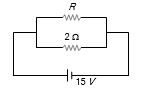
If in the circuit, power dissipation is $150\, W$, then $R$ is ............... $\Omega$
AIEEE 2002, Medium
Download our app for free and get started
(b) $P = \frac{{{V^2}}}{{{R_{eq}}}} \Rightarrow 150 = \frac{{{{(15)}^2}}}{{[2R/(R + 2)]}} = \frac{{225 \times (R + 2)}}{{2R}}$
$ \Rightarrow $ $R = \frac{{450}}{{75}} = 6\,\Omega $.
$ \Rightarrow $ $R = \frac{{450}}{{75}} = 6\,\Omega $.

Download our appand get started for free
Experience the future of education. Simply download our apps or reach out to us for more information. Let's shape the future of learning together!No signup needed.*
Similar Questions
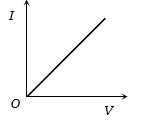
- 1$I-V$ characteristic of a copper wire of length $L$ and area of cross-section $A$ is shown in figure. The slope of the curve becomesView Solution
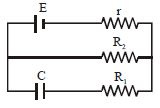
- 2In the given figure each plate of capacitance $C$ has partial value of chargeView Solution
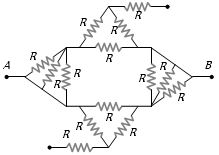
- 3Find equivalent resistance between $A$ and $B$View Solution
- 4A copper wire of length $10\,m$ and radius $\left(10^{-2} / \sqrt{\pi}\right) m$ has electrical resistance of $10 \,\Omega$. The current density in the wire for an electric field strength of $10( V / m )$ is :View Solution
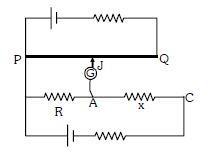
- 5Circuit for the measurement of resistance by potentiometer is shown. The galvanometer is first connected at point $A$ and zero deflection is observed at length $P J = 10\ cm$ . In second case it is connected at point $C$ and zero deflection is observed at a length $30\ cm$ from $P$ . Then the unknown resistance $X$ isView Solution
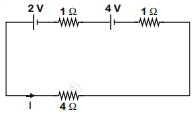
- 6For the circuit shown in the figure, the current $I$ will be .......$A$View Solution
- 7A potentiometer wire of length $1\,m$ and resistance $10\,\Omega$ is connected in series with a cell of $emf$ $2\,V$ with internal resistance $1 \,\Omega$ and a resistance box including a resistance $R$. If potential difference between the ends of the wire is $1\, mV$, the value of $R$ is ............. $\Omega $View Solution
- 8View SolutionThe lead wires should have
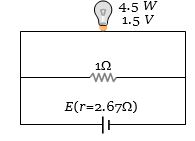
- 9A torch bulb rated as $4.5\, W$, $1.5\, V$ is connected as shown in the figure. The $e.m.f.$ of the cell needed to make the bulb glow at full intensity is ................ $V$View Solution
- 10By a cell a current of $0.9\, A$ flows through $2\, ohm$ resistor and $0.3\,A$ through $7\, ohm$ resistor. The internal resistance of the cell is ............ $\Omega$View Solution