If in the experiment of Wheatstone's bridge, the positions of cells and galvanometer are interchanged, then balance points will
AIIMS 2017, Easy


Download our appand get started for free
Experience the future of education. Simply download our apps or reach out to us for more information. Let's shape the future of learning together!No signup needed.*
Similar Questions
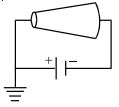
- 1$A$ conductor is made of an isotropic material and has shape of a truncated cone. $A$ battery of constant emf is connected across it and its left end is earthed as shown in figure. If at a section distant $x$ from left end, electric field intensity, potential and the rate of generation of heat per unit length are $E, V$ and $H$ respectively, which of the following graphs is are correct?View Solution
- 2Assertion $(A):$ In a meter bridge experiment, null point for an unknown resistance is put inside an enclosure maintained at a higher temperature. The null point can be obtained at the same $p$ as before by decreasing the value of the standard resistance.View Solution
Reason $(R):$ Resistance of metal increases with increase in temperature.
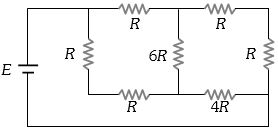
- 3A battery of internal resistance $4$ $\Omega$ is connected to the network of resistances as shown. In order to give the maximum power to the network, the value of $R$ (in $\Omega $) should beView Solution
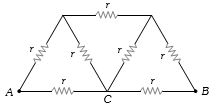
- 4In the circuit shown, the value of each resistance is $r$, then equivalent resistance of circuit between points $A$ and $B$ will beView Solution
- 5To get the maximum current from a parallel combination of $n$ identical cells each of internal resistance $r$ in an external resistance $R$, whenView Solution
- 6A rise of temperature of $4\,^oC$ is observed in a conductor by passing a current. If the current is tripled, the rise temperature will be .............. $^oC$View Solution
- 7If $400\; \Omega$ of resistance is made by adding four $100\; \Omega$ resistance of tolerance $5 \%$ then the tolerance of the combination is .....$\%$View Solution
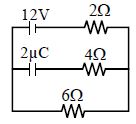
- 8Find the charge on the capacitor $C$ in the given circuit .................. $\mu C$View Solution
- 9In the circuit shown in figure potential difference between points A and $B$ is $16\,V$. the current passing through $2 \Omega$ resistance will be $...........\,A$View Solution
- 10For a cylinder of radius $R$ current density $J =J_0 \frac{r}{R} $, where $J_0$ is a constant and $r$ is distance from axis. Calculate total currentView Solution