Question
If $\left[\begin{array}{lll}1 & 1 & 1 \\ 0 & 1 & 1 \\ 0 & 0 & 1\end{array}\right]\left[\begin{array}{l}x \\ y \\ z\end{array}\right]=\left[\begin{array}{l}6 \\ 3 \\ 2\end{array}\right]$, then the value of $(2 x+y-z)$ is

Answer

$\left[\begin{array}{lll}1 & 1 & 1 \\0 & 1 & 1 \\0 & 0 & 1\end{array}\right]\left[\begin{array}{l}x \\y \\z\end{array}\right]=\left[\begin{array}{l}6 \\3 \\2 \end{array}\right] $
$\therefore x+y+z=6 .....(i)$
$y+z=3........(ii)$
$ z=2.......(iii)$
$\Rightarrow y+2=3$
$[$Using $(ii)$ and $(iii)]$
$\Rightarrow y=1$
$\Rightarrow x+1+2=6$
$\Rightarrow x=3$
$[$Using $(i), (iii)$ and $(iv)]$
So, $2 x+y-z$
$=(2 \times 3)+1-2$
$=6+1-2$
$=5$

Need a full question paper?

Generate a complete, print-ready paper with questions like this in minutes — across 16+ boards, with answer keys.
Start Generating Free

Similar questions

If A and B are two events, then $\text{P}(\overline{\text{A}}\cap\text{B})=$
The distance of the plane through the intersection of the planes ax + by + cz +d = 0 and lx + my + nz + P = 0 and parallel to the line y = 0, z = 0
  1. (bl - am)y + (cl - an)z + dl - ap = 0
  2. (am - bl)x + (mc - bn)z + md - bp = 0
  3. (na - cl)x + (bn - cm)y + nd - cp = 0
  4. None of these
For any two vectors $\vec{a}$ and $\vec{b}$, which of the following statements is always true?
If $\text{f(x)}=|\log_{10}\text{x}|\text{fx}=\log_{10}\text{x},$ then at x = 1:
  1. f(x) is continuous and $\text{f}'(1^+)=\log_{10}\text{e}$
  2. f(x) is continuous and $\text{f}'(1^+)=\log_{10}\text{e}$
  3. f(x) is continuous and $\text{f}'(1^-)=-\log_{10}\text{e}$
  4. f(x) is continuous and $\text{f}'(1^-)=-\log_{10}\text{e}$
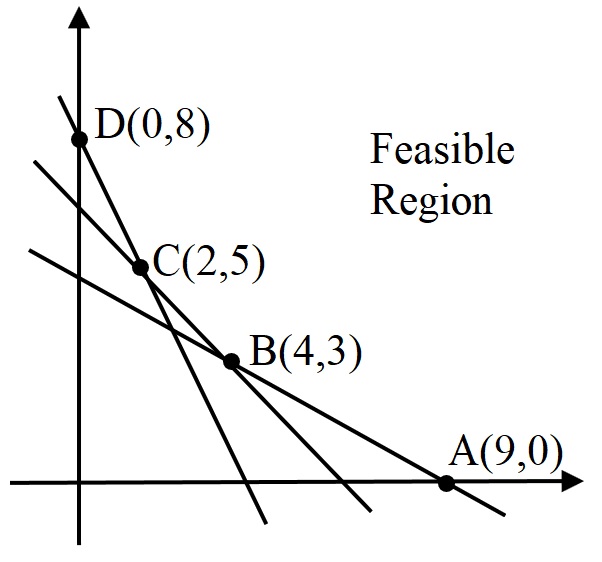
The feasible region for an LPP is shown shaded in the following figure. Minimum of Z = 4x + 3y occurs at the point.
Let $A=\{a, b, c\}$ and let $R=\{(a, a),(a, b)$, $(b, a)\}$. Then, $R$ is
Choose the correct answer from the given four options:
The area of the region bounded by the curve $\text{y}=\sqrt{16-\text{x}^2}$ and x-axis is:
  1. $8\text{ sq. units}$
  2. $20\pi\text{ sq. units}$
  3. $16\pi\text{ sq. units}$
  4. $256\pi\text{ sq. units}$
A bag containe 5 black, 4white balls and 3 red balls. if a ball is selected randomwise, the probability that it is black or red ball is,
  1. $\frac{1}{3}$
  2. $\frac{1}{4}$
  3. $\frac{5}{12}$
  4. $\frac{2}{3}$
The angle between the planes 2x - y + z = 6 and x + y + 2z = 7 is:
  1. $\frac{\pi}{4}$
  2. $\frac{\pi}{6}$
  3. $\frac{\pi}{3}$
  4. $\frac{\pi}{2}$
If $|\vec{\text{a}}|=\big|\vec{\text{b}}\big|,$ then $\big(\vec{\text{a}}+\vec{\text{b}}\big).\big(\vec{\text{a}}-\vec{\text{b}}\big)=$
  1. Positive
  2. Negetive
  3. 0
  4. None of these