If $n,\,e,\,\tau $ and $m$ respectively represent the density, charge relaxation time and mass of the electron, then the resistance of a wire of length $l$ and area of cross-section $A$ will be
Easy


Download our appand get started for free
Experience the future of education. Simply download our apps or reach out to us for more information. Let's shape the future of learning together!No signup needed.*
Similar Questions
- 1If the current through a resistor in a circuit increases by $3 \%$, then the power dissipated by the resistorView Solution
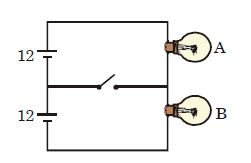
- 2Two light bulbs in the circuit have rating $A\,[24\ V, 48\,W]$ and $B\,[24\ V, 36\,W]$ as shown.View Solution
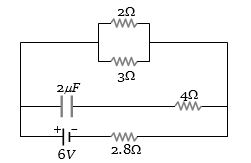
- 3In the figure shown, the capacity of the condenser $C$ is $2\,\mu F$. The current in $2\,\Omega $ resistor is ............... $A$View Solution
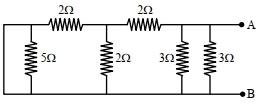
- 4The equivalent resistance of the given circuit between the terminals ${A}$ and ${B}$ is $....\Omega$View Solution
- 5A uniform metallic wire has a resistance of $18\,\Omega $ and is bent into an equilateral triangle. Then, the resistance between any two vertices of the triangle is .................. $\Omega$View Solution
- 6In the circuit as shown in the figure, the heat produced by $6\, ohm$ resistance due to current flowing in it is $60$ calorie per second. The heat generated across $3\, ohm$ resistance per second will be ................. $calorie$View Solution
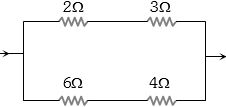
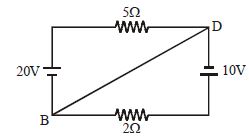
- 7Calculate the current in wire $BD$ ................ $A$View Solution
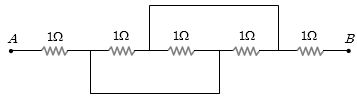
- 8Equivalent resistance between the points $A$ and $B$ is (in $\Omega$)View Solution
- 9A potentiometer is used for the comparison of $e.m.f.$ of two cells ${E_1}$ and ${E_2}$. For cell ${E_1}$ the no deflection point is obtained at $20\,cm$ and for ${E_2}$ the no deflection point is obtained at $30\,cm$. The ratio of their $e.m.f.$'s will beView Solution
- 10Kirchhoff's first law $i.e.$ $\Sigma i = 0$ at a junction is based on the law of conservation ofView Solution