Kirchhoff's first law $i.e.$ $\Sigma i = 0$ at a junction is based on the law of conservation of
AIIMS 2000,AIPMT 1997,AIPMT 1992, Easy


Download our appand get started for free
Experience the future of education. Simply download our apps or reach out to us for more information. Let's shape the future of learning together!No signup needed.*
Similar Questions
- 1In a meter bridge, the balancing length from the left end (standard resistance of $1 \,ohm$ is in the right gap) is found to be $20\, cm$. The value of the unknown resistance is ............... $\Omega$View Solution
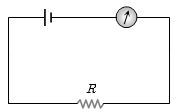
- 2A battery of $e.m.f.$ $10\, V$ and internal resistance $3\,\Omega $ is connected to a resistor as shown in the figure. If the current in the circuit is $0.5\, A$. then the resistance of the resistor will be ............. $\Omega$View Solution
- 3A copper wire of length $10\,m$ and radius $\left(10^{-2} / \sqrt{\pi}\right) m$ has electrical resistance of $10 \,\Omega$. The current density in the wire for an electric field strength of $10( V / m )$ is :View Solution
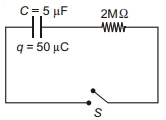
- 4The following circuit consist of a $5 \,\mu F$ capacitor, having charge $50 \,\mu C$ as shown. The switch is closed at $t=0$. The value of current in $2 \,M \Omega$ resistor at $t=0$ is ........... $\mu A$View Solution
- 5Four equal resistance dissipated $5 \,W$ of power together when connected in series to a battery of negligible internal resistance. The total power dissipated in these resistance when connected in parallel across the same battery would be ........... $W$View Solution
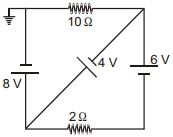
- 6In the circuit shown in figure, all cells are ideal. The current through $2 \,\Omega$ resistor is ............ $A$View Solution
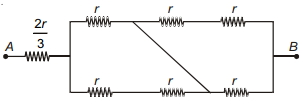
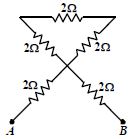
- 7For the circuit shown in the figure , the equivalent resistance between $A$ and $B$ is ............. $\Omega$View Solution
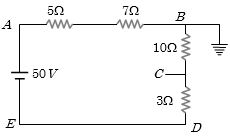
- 8In the circuit shown, the point ‘$B$’ is earthed. The potential at the point ‘$A$’ is ............. $V$View Solution
- 9A steady current $I$ is set up in a wire whose cross-sectional area decreases in the direction of the flow of the current. Then, as we examine the narrowing region,View Solution
- 10The effective resistance of the network between points $A$ and $B$ isView Solution