The current in a conductor is expressed as $I=3 t^2+4 t^3$, where $I$ is in Ampere and $t$ is in second. The amount of electric charge that flows through a section of the conductor during $t=1$ s to $t=2 \mathrm{~s}$ is_______ C.
JEE MAIN 2024, Diffcult
Download our app for free and get started
$q=\int_1^2 i d t=\int_1^2\left(3 t^2+4 t^3\right) d t$
$q=\left.\left(t^3+t^4\right)\right|_1 ^2$
$q=22 C$

Download our appand get started for free
Experience the future of education. Simply download our apps or reach out to us for more information. Let's shape the future of learning together!No signup needed.*
Similar Questions
- 1The resistance of platinum wire at $0^{\circ}\,C$ is $2\,\Omega$ and $6.8\,\Omega$ at $80^{\circ} \,C$. The temperature coefficient of resistance of the wire is :View Solution
- 2You are given three bulbs of $25$, $40$ and $60\, watt$. Which of them has lowest resistanceView Solution
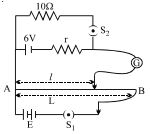
- 3In the arrangement shown in figure when the switch $S_2$ is open, the galvanometer shows no deflection for $l = L/2$. When the switch $S_2$ is closed, the galvanometer shows no deflection for $l = 5L /12$ . The internal resistance $(r)$ of $6\, V$ cell, and the $\mathrm{emf}$ $E$ of the other battery are respectivelyView Solution
- 4By what percentage will the illumination of the lamp decrease if the current drops by $20 \%$ ?View Solution
- 5The resistivity $(\rho)$ of semiconductor varies with temperature. Which of the following curve represents the correct behaviourView Solution
- 6View SolutionWhen electric bulbs of same power, but different marked voltage are connected in series across the power line, their brightness will be :
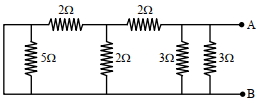
- 7The equivalent resistance of the given circuit between the terminals ${A}$ and ${B}$ is $....\Omega$View Solution
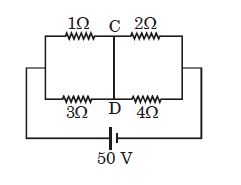
- 8In the given circuit diagram, find the current passing through wire $CD$ (in ampere)View Solution
- 9A cell of emf $6\, V$ and resistance $0.5\, ohm$ is short circuited. The current in the cell is ............... $amp$View Solution
- 10In a region $10^{19}$ $\alpha -$ particels and $10^{19}$ protons per second move to the left, while $10^{19}$ electrons moves to the right per second. The current isView Solution