If $x, v$ and $a$ denote the displacement, the velocity and the acceleration of a particle executing simple harmonic motion of time period $T$, then, which of the following does not change with time?
AIEEE 2009, Medium
Download our app for free and get started
For an $SHM$, the acceleration $a=-\omega^{2} x$ where $\omega^{2}$
is a constant. Therefore $\frac{a}{x}$ is a constant. The time period
$T$ is also constant. Therefore $\frac{a T}{x}$ is a constant.

Download our appand get started for free
Experience the future of education. Simply download our apps or reach out to us for more information. Let's shape the future of learning together!No signup needed.*
Similar Questions
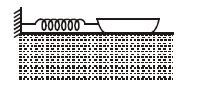
- 1A steady force of $120\ N$ is required to push a boat of mass $700\ kg$ through water at a constant speed of $1\ m/s$ . If the boat is fastened by a spring and held at $2\ m$ from the equilibrium position by a force of $450\ N$ , find the angular frequency of damped $SHM$ ..... $rad/s$View Solution
- 2A pendulum has time period $T$. If it is taken on to another planet having acceleration due to gravity half and mass $ 9 $ times that of the earth then its time period on the other planet will beView Solution
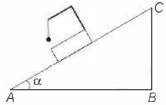
- 3A simple pendulum is attached to a block which slides without friction down an inclined plane $A B C$ having an angle of inclination $\alpha$ as shown below. While the block is sliding down the pendulum oscillates in such a way that at its mean position the direction of the string isView Solution
- 4A block of mass $m$ attached to massless spring is performing oscillatory motion of amplitude $'A'$ on a frictionless horizontal plane. If half of the mass of the block breaks off when it is passing through its equilibrium point, the amplitude of oscillation for the remaining system become $fA.$ The value of $f$ isView Solution
- 5A particle performs simple harmonic oscillation of period $T$ and the equation of motion is given by;View Solution
$x = a\,\sin \,\left( {\omega t + \pi /6} \right)$
After the elapse of what fraction of the time period the velocity of the particle will be equal to half of its maximum velocity?
- 6Four simple harmonic vibrations:View Solution
${y_1} = 8\,\cos\, \omega t;\,{y_2} = 4\,\cos \,\left( {\omega t + \frac{\pi }{2}} \right)$ ;
${y_3} = 2\cos \,\left( {\omega t + \pi } \right);\,{y_4} = \,\cos \,\left( {\omega t + \frac{{3\pi }}{2}} \right)$ ,
are superposed on each other. The resulting amplitude and phase are respectively;
- 7A linear harmonic oscillator of force constant $2 \times {10^6}N/m$ and amplitude $0.01\, m$ has a total mechanical energy of $160$ joules. ItsView Solution
- 8A particle of mass $10\, gm$ is describing $S.H.M.$ along a straight line with period of $2\, sec$ and amplitude of $10, cm$. Its kinetic energy when it is at $5 \,cm$ from its equilibrium position isView Solution
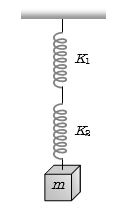
- 9A mass $M$ is suspended by two springs of force constants $K_1$ and $K_2$ respectively as shown in the diagram. The total elongation (stretch) of the two springs isView Solution
- 10A spring mass system executes damped harmonic oscillations given by the equationView Solution
$y = A{e^{ - \frac{{bt}}{{2m}}}}\sin (\omega 't + \phi )$
where the symbols have their usual meanings. If a $2\ kg$ mass $(m)$ is attached to a spring of force constant $(K)$ $1250\ N/m$ , the period of the oscillation is $\left( {\pi /12} \right)s$ . The damping constant $‘b’$ has the value. ..... $kg/s$