A particle of mass $10\, gm$ is describing $S.H.M.$ along a straight line with period of $2\, sec$ and amplitude of $10, cm$. Its kinetic energy when it is at $5 \,cm$ from its equilibrium position is
Easy
Download our app for free and get started
(c) Kinetic energy $K = \frac{1}{2}m{\omega ^2}({a^2} - {y^2})$
$ = \frac{1}{2} \times 10 \times {\left( {\frac{{2\pi }}{2}} \right)^2}[{10^2} - {5^2}]$
$ = \frac{1}{2} \times 10 \times {\left( {\frac{{2\pi }}{2}} \right)^2}[{10^2} - {5^2}]$
$ = 375\;{\pi ^2}ergs$

Download our appand get started for free
Experience the future of education. Simply download our apps or reach out to us for more information. Let's shape the future of learning together!No signup needed.*
Similar Questions
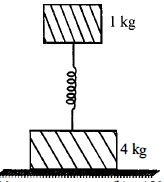
- 1Two bodies of masses $1\, kg$ and $4\, kg$ are connected to a vertical spring, as shown in the figure. The smaller mass executes simple harmonic motion of angular frequency $25\, rad/s$, and amplitude $1.6\, cm$ while the bigger mass remains stationary on the ground. The maximum force exerted by the system on the floor is ..... $N$ ( take $g = 10\, ms^{-2}$)View Solution
- 2A cuboidal piece of wood has dimensions $a, b$ and $c$. Its relative density is $d$. It is floating in a large body of water such that side a is vertical. It is pushed down a bit and released. The time period of $SHM$ executed by it is :View Solution
- 3Two, spring $P$ and $Q$ of force constants $k_p$ and ${k_Q}\left( {{k_Q} = \frac{{{k_p}}}{2}} \right)$ are stretched by applying forces of equal magnitude. If the energy stored in $Q$ is $E$, then the energy stored in $P$ isView Solution
- 4In an engine the piston undergoes vertical simple harmonic motion with amplitude $7\, cm$ . A washer rests on top of the piston and moves with it. The motor speed is slowly increased. The frequency of the piston at which the washer no longer stays in contact with the piston, is close to ...... $Hz$View Solution
- 5A particle is performing simple harmonic motionView Solution
$(i)$ its velocity-displacement graph is parabolic in nature
$(ii)$ its velocity-time graph is sinusoidal in nature
$(iii)$ its velocity-acceleration graph is elliptical in nature
Correct answer is - 6View SolutionA simple pendulum is vibrating in an evacuated chamber, it will oscillate with
- 7The ratio of frequencies of two pendulums are $2 : 3$, then their length are in ratioView Solution
- 8For a simple pendulum, a graph is plotted between its kinetic energy $(KE)$ and potential energy $(PE)$ against its displacement $d.$ Which one of the following represents these correctly ? (graphs are schematic and not drawn to scale)View Solution
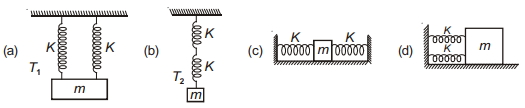
- 9A mass $m$ is attached to two springs of same force constant $K$, as shown in following four arrangements. If $T_1, T_2, T_3$ and $T_4$ respectively be the time periods of oscillation in the following arrangements, in which case time period is maximum?View Solution
- 10A simple pendulum with iron bob has a time period $T$. The bob is now immersed in a non-viscous liquid and oscillated. If the density of liquid is $\frac{1}{12}$ th that of iron, then new time period will beView Solution