In a balanced Wheatstone’s network, the resistances in the arms $Q$ and $S$ are interchanged. As a result of this
Easy
Download our app for free and get started
We know that in In a balanced Wheatstone's network,
$\frac{ P }{ Q }=\frac{ R }{ S }$
If $Q$ is replaced by $S$ then ratio becomes $\frac{P}{S}=\frac{R}{Q}$ which is not equal to the previous ratio. Hence, network is not balanced.

Download our appand get started for free
Experience the future of education. Simply download our apps or reach out to us for more information. Let's shape the future of learning together!No signup needed.*
Similar Questions
- 1View SolutionThe positive temperature coefficient of resistance is for
- 2A rod of a certain metal is $1.0\, m$ long and $0.6\, cm$ in diameter. Its resistance is $3.0 × {10^{ - 3}}\, ohm$. Another disc made of the same metal is $2.0\, cm$ in diameter and $1.0\, mm$ thick. What is the resistance between the round faces of the discView Solution
- 3View SolutionWhich device can convert all electrical energy into heat
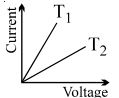
- 4The current in a metallic conductor is plotted against voltage at two different temperatures $T_1$ and $T_2$. Which is correctView Solution
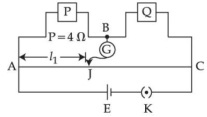
- 5Resistance are connected in a meter bridge circuit as shown in the figure. The balancing length $l_{1}$ is $40\,cm$. Now an unknown resistance $x$ is connected in series with $P$ and new balancing length is found to be $80\,cm$ measured from the same end. Then the value of $x$ will be $.......\Omega$View Solution
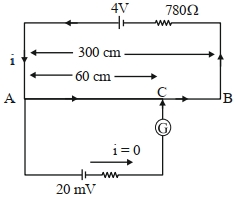
- 6A potentiometer wire of length $300\,cm$ is connected in series with a resistance $780\,\Omega$ and a standard cell of emf $4\,V$. A constant current flows through potentiometer wire. The length of the null point for cell of emf $20\,mV$ is found to be $60\,cm$. The resistance of the potentiometer wire is$...\Omega$View Solution
- 7A material '$B$' has twice the specific resistance of '$A$'. A circular wire made of '$B$' has twice the diameter ofa wire made of '$A$'. then for the two wires to have the same resistance, the ratio $\frac{{{l_B}}}{{{l_A}}}$ of their respective lengths must beView Solution
- 8View SolutionIf in the experiment of Wheatstone's bridge, the positions of cells and galvanometer are interchanged, then balance points will
- 9The drift velocity of free electrons in a conductor is ‘$v$’ when a current ‘$i$’ is flowing in it. If both the radius and current are doubled, then drift velocity will beView Solution
- 10View SolutionThe brightness of a bulb will be reduced, if a resistance is connected in