If in the experiment of Wheatstone's bridge, the positions of cells and galvanometer are interchanged, then balance points will
AIIMS 2017, Easy
Download our app for free and get started
(b) The actual circuit is same.

Download our appand get started for free
Experience the future of education. Simply download our apps or reach out to us for more information. Let's shape the future of learning together!No signup needed.*
Similar Questions
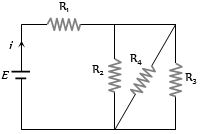
- 1In the circuit given $E = 6.0 \,V, R_1 = 100\, ohms, R_2 = R_3 = 50\, ohms, R_4 = 75\, ohms$. The equivalent resistance of the circuit, in $ohms$, isView Solution
- 2Water fall from a $40\,m$ high dam at the rate of $9 \times 10^{4}\,kg$ per $hour$. Fifty percentage of gravitational potential energy can be converted into electrical energy. Using this hydroelectric energy number of $100\,W$ lamps, that can be lit, isView Solution
(Take $\left.g=10\,ms ^{-2}\right)$
- 3Two cells, $e.m.f.$ of each is $E$ and internal resistance $r$ are connected in parallel between the resistance $R$. The maximum energy given to the resistor will be, only whenView Solution
- 4View SolutionA wire of a certain material is stretched slowly by ten percent. Its new resistance and specific resistance become respectively
- 5An electric lamp is marked $60\, W$, $ 230\, V$. The cost of $1\, kilowatt$ hour of power is Rs. $1.25$. The cost of using this lamp for $8$ hours is Rs. ................View Solution
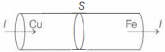
- 6Two rods of copper and iron with the same cross-sectional area are joined at $S$ and a steady current $I$ flows through the rods as shown in the figure. Choose the most appropriate representation of charges accumulated near the junction $S$.View Solution
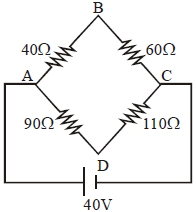
- 7Four resistances $40 \ \Omega, 60\ \Omega, 90\ \Omega$ and $110\ \Omega$ make the arms of a quadrilateral $A,B,C,D$. Across $AC$ is a battery of emf $40\, V$ and internal resistance negligible. The potential difference across $BD$ is $V$ is......View Solution
- 8View SolutionIdentify the set in which all the three materials are good conductors of electricity
- 9If an electron revolves in the path of a circle of radius of $0.5 × 10^{-10}\, m$ at frequency of $5 × 10^{15}$ $cycles/s$ the electric current in the circle is ..................$mA$ (Charge of an electron $=1.6 × 10^{-19}\, C$ )View Solution
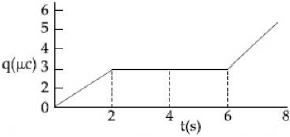
- 10The charge on a capacitor plate in a circuit, as a function of time, is shown in the figureView Solution
What is the value of current at $t = 4\,s$ ? ............... $\mu A$