Question

In a diode valve the cathode temperature must be (f = work function)

(a) High and  should be high

(b) High and should be low

(c) Low and should be high

(d) Low and should be high

Answer

(b) High and should be low

Need a full question paper?

Generate a complete, print-ready paper with questions like this in minutes — across 16+ boards, with answer keys.

Start Generating Free

Similar questions

Suppose potential energy between electron and proton at separation r is given by U = K ln (r), where K is a constant. For such a hypothetical hydrogen atom, the ratio of energy difference between energy levels (n = 1 and n = 2) and (n = 2 and n = 4) is?
Lenz's law is a direct consequence of:

The electric potential at the surface of an atomic nucleus (Z = 50) of radius 9.0 ×   cm is

(a) 80 volts

(b) 8  volts

(c) 9 volts

(d) 9  volts

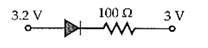
The current in the circuit shown in the figure considering ideal diode is
Image
The heat produced in a conductor of resistance R due to flow of current 'I' for time 't' is :
A magnetic field can be produced by:
  1. A moving charge.
  2. A changing electric field.
  3. Neither of them.
  4. Both of them.
A wavefront is an imaginary surface where:

Assertion   :   In practical application, power rating of resistance is not important.

Reason      : Property of resistance remain same even at high temperature.

(a) If both assertion and reason are true and the reason is the correct explanation of the assertion.

(b) If both assertion and reason are true but reason is not the correct explanation of the assertion.

(c) If assertion is true but reason is false.

(d) If the assertion and reason both are false.

An AC source producing emf $\in=\in_{0}\Big[\cos\big(100\pi\text{s}^{-1}\big)\text{t}+\cos\big(500\pi\text{s}^{-1}\big)\text{t}\Big]$ is connected in series with a capacitor and a resistor. The steady-state current in the circuit is found to be $\text{i}=\text{i}_1\cos\Big[\big(100\pi\text{s}^{-1}\big)\text{t}+\phi_1\Big]+\text{i}_2\cos\Big[\big(500\pi\text{s}^{-1}\big)\text{t}+\phi_2\Big].$
  1. i1 > i2
  2. i1 = i2
  3. i1 < i2
  4. The information is insufficient to find the relation between i1 and i2
A gas kept in a container of finite conductivity is suddenly compressed. The process:
  1. Must be very nearly adiabatic.
  2. Must be very nearly isothermal.
  3. May be very nearly adiabatic.
  4. May be very nearly isothermal.