Question
In a double-slit experiment the angular width of a fringe is found to be 0.2° on a screen placed 1 m away. The wavelength of light used is 600 nm. What will be the angular width of the fringe if the entire experimental apparatus is immersed in water? Take refractive index of water to be 4/3.
Answer

Distance of the screen from the slits, D = 1 m
Wavelength of light used, $\lambda_1$ = 600 nm
Angular width of the fringe in are, $\theta_1=0.2^{\circ}$
Angular width of the fringe in water $=\theta_2$
Refractive index of water, $\mu=\frac{4}{3}$
Refractive index is related to angular width as:
$\mu=\frac{{\theta}_1}{\theta_2}$
$\theta_2=\frac{3}{4}\theta_1$
$=\frac{3}{4}\times0.2=0.15$
Therefore, the angular width of the fringe in water will reduce to 0.15°.

Need a full question paper?

Generate a complete, print-ready paper with questions like this in minutes — across 16+ boards, with answer keys.

Start Generating Free

Similar questions

An $ \alpha $-particle and a proton are accelerated through the same potential difference. Find the ratio of their de-Broglie wavelength.
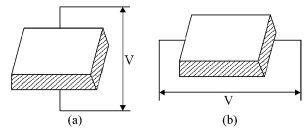
In a given figure, a rectangular object is shown. Its length is I, breadth is 0.5 I and thickness 0.25 I . To measure its resistance, potential difference $V$ is applied in two ways [figure (a) and (b)]. In which arrangement, the resistance of the substance will be more?
Image
You are driving a motorcycle on a horizontal road. It is moving with a uniform velocity. Is it possible to accelerate the motoreyle without putting higher petrol input rate into the engine?
A string is wrapped over the edge of a uniform disc and the free end is fixed with the ceiling. The disc moves down, unwinding the string. Find the downward acceleration of the disc.
Compare the direction of the magnetic field inside a solenoid with that of the field there if the solenoid is replaced by its equivalent combination of north pole and south pole.
What is diffraction? Which are the factors on which diffraction depends ? Give some examples of day to day life where the diffraction phenomenon is observed.
The plates of a parallel-plate capacitor are made of circular discs of radii 5.0cm each. If the separation between the plates is 1.0mm, what is the capacitance?
What happens to the energy of light waves in interference?
Can two identical and independent sodium lamps act as coherent sources? Give reason for your answer.
An electron is placed in an electric field. If a proton is placed in its place, what will be the relation between the forces experienced by them?