In a potentiometer arrangement, a cell gives a balancing point at $75\, cm$ length of wire. This cell is now replaced by another cell of unknown emf. If the ratio of the emf's of two cells respectively is $3: 2$, the difference in the balancing length of the potentiometer wire in above two cases will be.........$cm .$
JEE MAIN 2022, Medium


Download our appand get started for free
Experience the future of education. Simply download our apps or reach out to us for more information. Let's shape the future of learning together!No signup needed.*
Similar Questions
- 1A battery of $6\, volts$ is connected to the terminals of a three meter long wire of uniform thickness and resistance of the order of $100\,\Omega $. The difference of potential between two points separated by $50\,cm$ on the wire will be .......... $V$View Solution
- 2Assume a hypothetical wire in which free electron density changes with temperature in proportionality $n\ \alpha \ T$ assuming $\tau $(Relaxation time of collision) and dimensions of wire remain unchanged with increasing temperature. Which one of the resistance $v/s$ temperature graph is trueView Solution
- 3Three light bulbs of $40\, W$, $60\, W$ and $100\, W$ are connected in series with $220\, V$ source. Which one of the bulbs will glow brightest ............ $W$View Solution
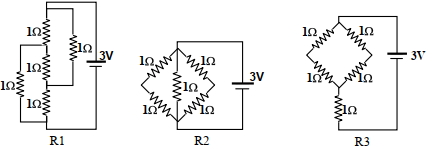
- 4Figure shows three resistor configurations $\mathrm{R} 1, \mathrm{R} 2$ and $\mathrm{R} 3$ connected to $3 \mathrm{~V}$ battery. If the power dissipated by the configuration $\mathrm{R} 1, \mathrm{R} 2$ and $\mathrm{R} 3$ is $\mathrm{P} 1, \mathrm{P} 2$ and $\mathrm{P} 3$, respectively, thenView Solution
Figure:
- 5View SolutionThe internal resistance of a cell depends on
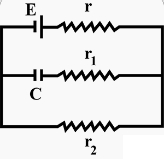
- 6In the given circuit diagram when the current reaches steady state in the circuit, the charge on the capacitor of capacitance $C$ will beView Solution
- 7A current of $2\,A$ flows through a wire of crosssectional area $25.0\,mm ^2$. The number of free electrons in a cubic meter are $2.0 \times 10^{28}$. The drift velocity of the electrons is $...............\times 10^{-6}\,ms ^{-1}$ (given, charge on electron $=1.6 \times 10^{-19}\,C$ )View Solution
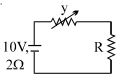
- 8In the figure shown the power generated in $y$ is maximum when $y = 5\,\Omega$ . Then $R$ is .............. $\Omega$View Solution
- 9By using only two resistance coils-singly, in series, or in parallel one should be able to obtain resistances of $3$, $4$, $12$ and $16\, ohms$. The separate resistances of the coil areView Solution
- 10Space between two concentric conducting spheres of radii $a$ and $b (b > a)$ is filled with $a$ medium of resistivity $\rho $. The resistance between the two spheres will beView Solution