Figure shows three resistor configurations $\mathrm{R} 1, \mathrm{R} 2$ and $\mathrm{R} 3$ connected to $3 \mathrm{~V}$ battery. If the power dissipated by the configuration $\mathrm{R} 1, \mathrm{R} 2$ and $\mathrm{R} 3$ is $\mathrm{P} 1, \mathrm{P} 2$ and $\mathrm{P} 3$, respectively, then
Figure: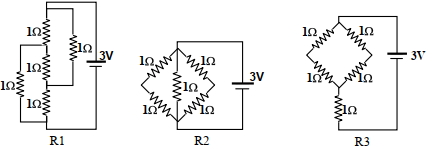
IIT 2008, Diffcult


Download our appand get started for free
Experience the future of education. Simply download our apps or reach out to us for more information. Let's shape the future of learning together!No signup needed.*
Similar Questions
- 1$A$ current passes through a wire of nonuniform cross section. Which of the following quantities are independent of the cross-section?View Solution
- 2At room temperature, copper has free electron density of $8.4 \times {10^{28}}$ per ${m^3}$. The copper conductor has a cross-section of $10^{-6} \,m^2$ and carries a current of $5.4\, A$. The electron drift velocity in copper isView Solution
- 3The resistance of a conductor is $5\, ohm$ at $50\,^oC$ and $6\, ohm$ at $100\,^oC$. Its resistance at $0\,^oC$ is ................ $ohm$View Solution
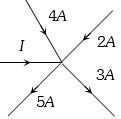
- 4In the given current distribution what is the value of $I$ .............. $A$View Solution
- 5The current in a simple series circuit is $5.0\, amp$. When an additional resistance of $2.0\, ohms$ is inserted, the current drops to $4.0\, amp$. The original resistance of the circuit in $ohms$ wasView Solution
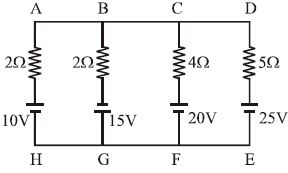
- 6In the given network current through branch $BG$ is almost equal to ............ $A$View Solution
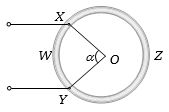
- 7A wire of resistor $R$ is bent into a circular ring of radius $r$. Equivalent resistance between two points $X$ and $Y$ on its circumference, when angle $XOY$ is $\alpha$, can be given byView Solution
- 8Resistances ${R_1}$ and ${R_2}$ are joined in parallel and a current is passed so that the amount of heat liberated is ${H_1}$ and ${H_2}$ respectively. The ratio $\frac{{{H_1}}}{{{H_2}}}$ has the valueView Solution
- 9Two resistors are joined in parallel whose, resultant is $\frac{6}{5} \,\Omega$. One of the resistance wire is broken and the effective resistance becomes $2 \,ohms$. Then the resistance (in $ohm$) of the wire that got broken is ..........View Solution
- 10View SolutionThe length of the wire is doubled. Its conductance will be