In a simple harmonic oscillation, what fraction of total mechanical energy is in the form of kinetic energy, when the particle is midway between mean and extreme position.
JEE MAIN 2021, Medium
Download our app for free and get started
$K =\frac{1}{2} m \omega^{2}\left( A ^{2}- x ^{2}\right)$
$=\frac{1}{2} m \omega^{2}\left( A ^{2}-\frac{ A ^{2}}{4}\right)$
$=\frac{1}{2} m \omega^{2}\left(\frac{3 A ^{2}}{4}\right)$
$K =\frac{3}{4}\left(\frac{1}{2} m \omega^{2} A ^{2}\right)$

Download our appand get started for free
Experience the future of education. Simply download our apps or reach out to us for more information. Let's shape the future of learning together!No signup needed.*
Similar Questions
- 1View SolutionA hollow sphere is filled with water through a small hole in it. It is then hung by a long thread and made to oscillate. As the water slowly flows out of the hole at the bottom, the period of oscillation will
- 2A particle at the end of a spring executes simple harmonic motion with a period ${t_1}$, while the corresponding period for another spring is ${t_2}$. If the period of oscillation with the two springs in series is $T$, thenView Solution
- 3A clock which keeps correct time at ${20^o}C$, is subjected to ${40^o}C$. If coefficient of linear expansion of the pendulum is $12 \times {10^{ - 6}}/^\circ C$. How much will it gain or loose in timeView Solution
- 4Two particles are executing simple harmonic motion of the same amplitude $A$ and frequency $\omega $ along the $x-$ axis. Their mean position is separated by distance $X_0 (X_0> A)$. If the maximum separation between them is $(X_0 +A)$, the phase difference between their motion isView Solution
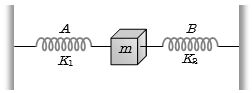
- 5View SolutionIn arrangement given in figure, if the block of mass m is displaced, the frequency is given by
- 6The displacement of a particle along the $x-$ axis is given by $x=asin^2$$\omega t$ . The motion of the particle corresponds toView Solution
- 7The displacement time equation of a particle executing $SHM$ is : $x = A \,sin\,(\omega t + \phi )$. At time $t = 0$ position of the particle is $x = A/2$ and it is moving along negative $x-$ direction. Then the angle $\phi $ can beView Solution
- 8A particle executes simple harmonic motion with an amplitude of $4 \,cm$. At the mean position the velocity of the particle is $10\, cm/s$. The distance of the particle from the mean position when its speed becomes $5 \,cm/s$ isView Solution
- 9A particle performs $S.H.M.$ of amplitude $A$ with angular frequency $\omega$ along a straight line. Whenit is at a distance $\frac{{\sqrt 3 }}{2}$ $A$ from mean position, its kinetic energy gets increased by an amount $\frac{1}{2}m{\omega ^2}{A^2}$ due to an impulsive force. Then its new amplitude becomesView Solution
- 10The vertical extension in a light spring by a weight of $1\, kg$ suspended from the wire is $9.8\, cm$. The period of oscillationView Solution