The vertical extension in a light spring by a weight of $1\, kg$ suspended from the wire is $9.8\, cm$. The period of oscillation
Easy
Download our app for free and get started
(c) $mg = kx$
==> $\frac{m}{k} = \frac{x}{g}$
==> $T = 2\pi \sqrt {\frac{m}{k}} = 2\pi \sqrt {\frac{x}{g}} $
$ = 2\pi \sqrt {\frac{{9.8 \times {{10}^{ - 2}}}}{{9.8}}} = \frac{{2\pi }}{{10}}\,sec$

Download our appand get started for free
Experience the future of education. Simply download our apps or reach out to us for more information. Let's shape the future of learning together!No signup needed.*
Similar Questions
- 1A pendulum clock that keeps correct time on the earth is taken to the moon it will run (it is given that $g_{Moon} = g_{Earth}/6$ )View Solution
- 2A particle is vibrating in a simple harmonic motion with an amplitude of $4\, cm.$ At what displacement from the equilibrium position, is its energy half potential and half kineticView Solution
- 3The potential energy of a particle with displacement $X$ is $U(X)$. The motion is simple harmonic, when ($K$ is a positive constant)View Solution
- 4Two particles $P$ and $Q$ describe simple harmonic motions of same period, same amplitude, along the same line about the same equilibrium position $O.$ When $P$ and $Q$ are on opposite sides of $O$ at the same distance from $O$ they have the same speed of $1.2 \,m/s$ in the same direction, when their displacements are the same they have the same speed of $1.6\, m/s$ in opposite directions. The maximum velocity in $m/s$ of either particle isView Solution
- 5The instantaneous displacement of a simple pendulum oscillator is given by $x = A\cos \left( {\omega t + \frac{\pi }{4}} \right)$. Its speed will be maximum at timeView Solution
- 6A pendulum bob has a speed of $3\, {m} / {s}$ at its lowest position. The pendulum is $50 \,{cm}$ long. The speed of bob, when the length makes an angle of $60^{\circ}$ to the vertical will be $ .......\,{m} / {s}$ $\left(g=10 \,{m} / {s}^{2}\right)$View Solution
- 7Aheavy brass sphere is hung from a light spring and is set in vertical small oscillation with a period $T.$ The sphere is now immersed in a non-viscous liquid with a density $1/10\,th$ the density of the sphere. If the system is now set in vertical $S.H.M.,$ its period will beView Solution
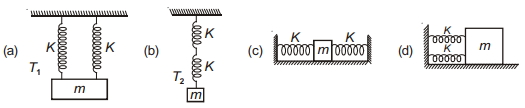
- 8A mass $m$ is attached to two springs of same force constant $K$, as shown in following four arrangements. If $T_1, T_2, T_3$ and $T_4$ respectively be the time periods of oscillation in the following arrangements, in which case time period is maximum?View Solution
- 9The displacement of a particle executing $SHM$ is given by $y=0.25 \sin 200 t$ $cm$. The maximum speed of the particle is $.........cm s^{-1}$View Solution
- 10A solid cylinder of density $\rho_0$, cross-section area $A$ and length $l$ floats in a liquid $\rho(> \rho_0)$ with its axis vertical, as shown. If it is slightly displaced downward and released, the time period will beView Solution
