MCQ
In a simple harmonic oscillator, at the mean position
  • A
    Kinetic energy is minimum, potential energy is maximum
  • B
    Both kinetic and potential energies are maximum
  • Kinetic energy is maximum, potential energy is minimum
  • D
    Both kinetic and potential energies are minimum
Answer

Correct option: C.
Kinetic energy is maximum, potential energy is minimum
(c)

Need a full question paper?

Generate a complete, print-ready paper with questions like this in minutes — across 16+ boards, with answer keys.

Start Generating Free

Similar questions

The isothermal bulk modulus of a perfect gas at normal pressure is
One mole of an ideal gas expands at a constant temperature of 300 $K$ from an initial volume of 10 litres to a final volume of 20 litres. The work done in expanding the gas is $(R=8.31 \mathrm{~J} / \mathrm{mole}-K)$
In a thermodynamics process, pressure of a fixed mass of a gas is changed in such a manner that the gas releases $20 \mathrm{~J}$ of heat and 8J of work is done on the gas. If the initial internal energy of the gas was $30 \%$. The final internal energy will be
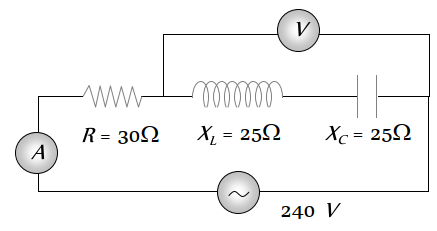
In the circuit shown in figure neglecting source resistance the voltmeter and ammeter reading will respectively, will be
Image
In hydrogen spectrum the wavelength of $H _\alpha$ line is $656 nm$ whereas in the spectrum of a distant galaxy, $H _\alpha$ line wavelength is $706 nm$. Estimated speed of the galaxy with respect to earth is [IIT-JEE 1999; UPSEAT 2003]
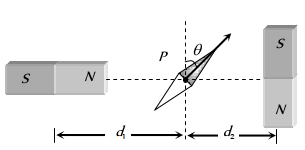
Two magnets $A$ and $B$ are identical and these are arranged as shown in the figure. Their length is negligible in comparison to the separation between them. A magnetic needle is placed between the magnets at point $P$ which gets deflected through an angle $\theta$ under the influence of magnets. The ratio of distance $d_1$ and $d_2$ will beImage
It takes 10 minutes to cool a liquid from $61 C$ to $59 C$. If room temperature is $30 . C$ then time taken in cooling from $5 \mathrm{l} C$ to $49 C$ is
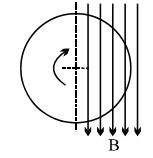
A thin non conducting disc of radius $R$ is rotating clockwise (see figure) with an angular velocity $w$ about its central axis, which is perpendicular to its plane. Both its surfaces carry $+ve$ charges of uniform surface density. Half the disc is in a region of a uniform, unidirectional magnetic field $B$ parallel to the plane of the disc, as shown. Then,
In a compound microscope, the intermediate image is
A sniper fires a rifle bullet into a gasoline tank making a hole $53.0 m$ below the surface of gasoline. The tank was sealed at $3.10 atm$. The stored gasoline has a density of $660 kgm$. The velocity with which gasoline begins to shoot out of the hole is