Question
In an electromagnetic wave both the electric and magnetic fields are perpendicular to the direction of propagation, that is why electromagnetic waves are transverse in nature. Electromagnetic waves carry energy as they travel through space and this energy is shared equally by the electric and magnetic fields. Energy density of an electromagnetic waves is the energy in unit volume of the space through which the wave travels.
  1. The electromagnetic waves propagated perpendicular to both $\vec{\text{E}}$ and $\vec{\text{B}}.$ The electromagnetic waves travel in the direction of.
  1. $\vec{\text{E}}\times\vec{\text{B}}$
  2. $\vec{\text{E}}\times\vec{\text{B}}$
  3. $\vec{\text{B}}\times\vec{\text{E}}$
  4. $\vec{\text{B}}\times\vec{\text{E}}$
  1. Fundamental particle in an electromagnetic wave is:
  1. Photon
  2. Electron
  3. Phonon
  4. Proton
  1. Electromagnetic waves are transverse in nature is evident by:
  1. Polarisation
  2. Interference
  3. Reflection
  4. Diffraction
  1. For a wave propagating in a medium, identify the property that is independent of the others.
  1. Velocity
  2. Wavelength
  3. Frequency
  4. All these depend on each other.
  1. The electric and magnetic fields of an electromagnetic waves are:
  1. In opposite phase and perpendicular to each other.
  2. In opposite phase and parallel to each other.
  3. In phase and perpendicular to each other.
  4. In phase and parallel to each other.
Answer

  1. (b) $\vec{\text{E}}\times\vec{\text{B}}$

Explanation:

Electromagnetic waves propagate in the direction of $\vec{\text{E}}\times\vec{\text{B}}.$

  1. (a) Photon

Explanation:

Photon is the fundamental particle in an electromagnetic wave.

  1. (a) Polarisation

Explanation:

Polarisation establishes the wave nature of electromagnetic waves.

  1. (c) Frequency

Explanation:

Frequency u remains unchanged when a wave propagates from one medium to another. Both wavelength and velocity get changed.

  1. (c) In phase and perpendicular to each other.

Explanation:

The electric and magnetic fields of an electromagnetic wave are in phase and perpendicular to each other.

Need a full question paper?

Generate a complete, print-ready paper with questions like this in minutes — across 16+ boards, with answer keys.

Start Generating Free

Similar questions

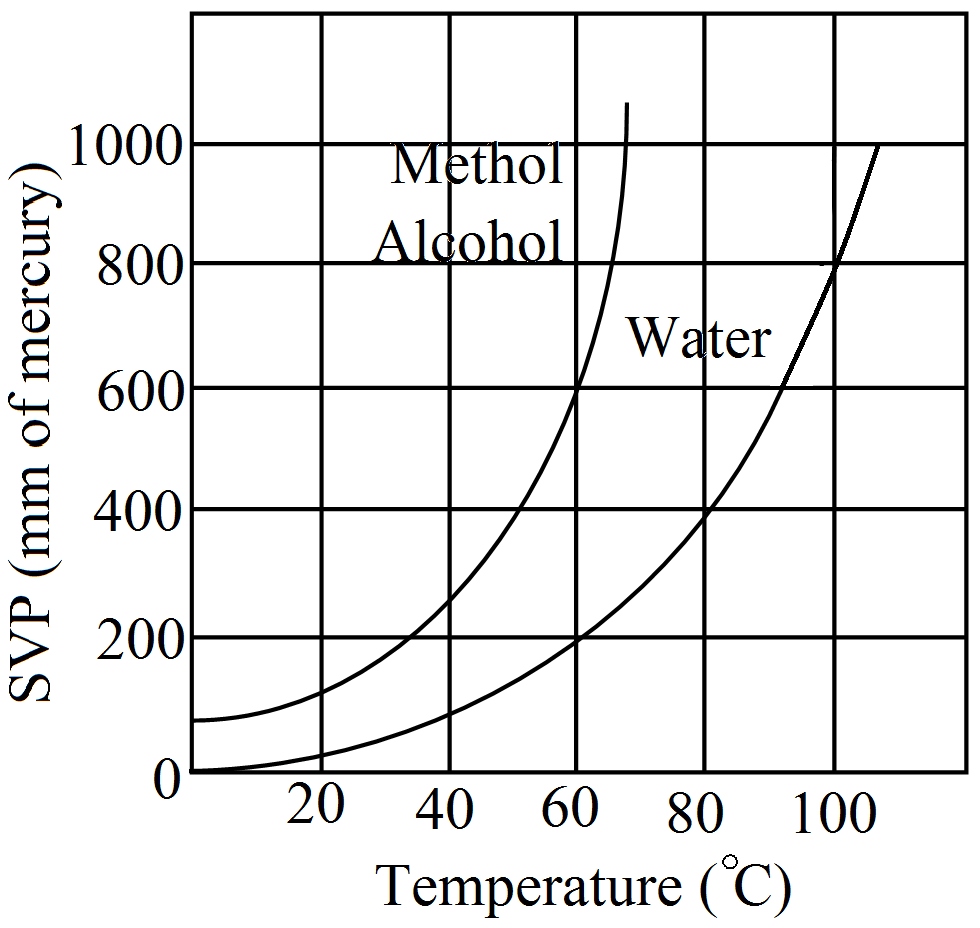
The human body has an average temperature of 98°F. Assume that the vapour pressure of the blood in the veins behaves like that of pure water. Find the minimum atmospheric pressure which is necessary to prevent the blood from boiling. Use figure. of the text for the vapour pressures.


A 4.5 cm needle is placed 12 cm away from a convex mirror of focal length 15 cm. Give the location of the image and the magnification. Describe what happens as the needle is moved farther from the mirror.
For the $L - C - R$ series AC circuit derive the phase relationship between instantaneous current and voltage, using the phasor diagram.
Two q charges of the same nature are located at a distance d from each other, the third charge of value Q Coulomb is at the mid-point of the line joining them. For what value of Q will the system be in equilibrium?
Mention the changes occurring in the geomagnetic components.
Draw a neat labelled diagram of human eye. Explain shortsightedness and longsightedness eye defects giving their cause and method of removal showing ray diagram.
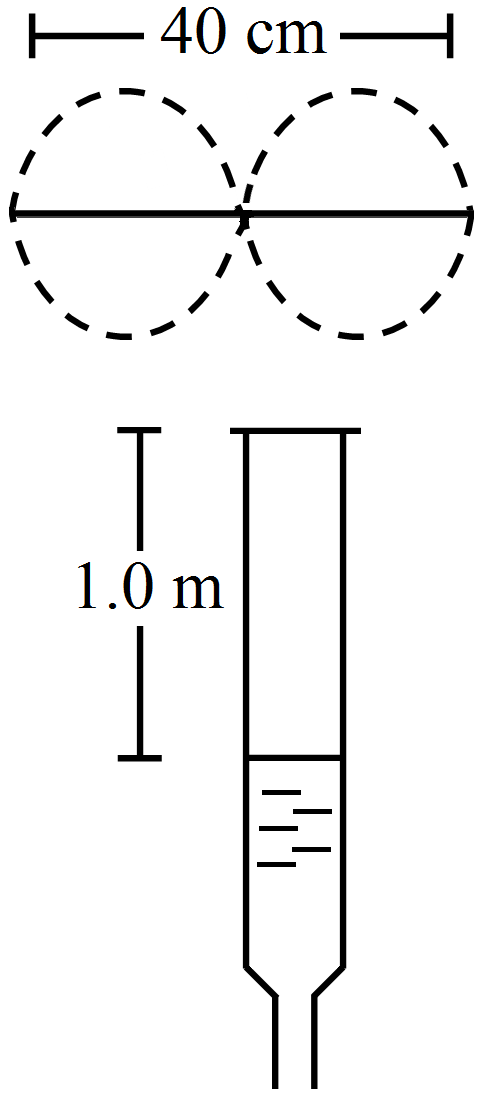
Consider the situation shown in figure. The wire which has a mass of 4.00g oscillates in its second harmonic and sets the air column in the tube into vibrations in its fundamental mode. Assuming that the speed of sound in air is 340m/s, find the tension in the wire.

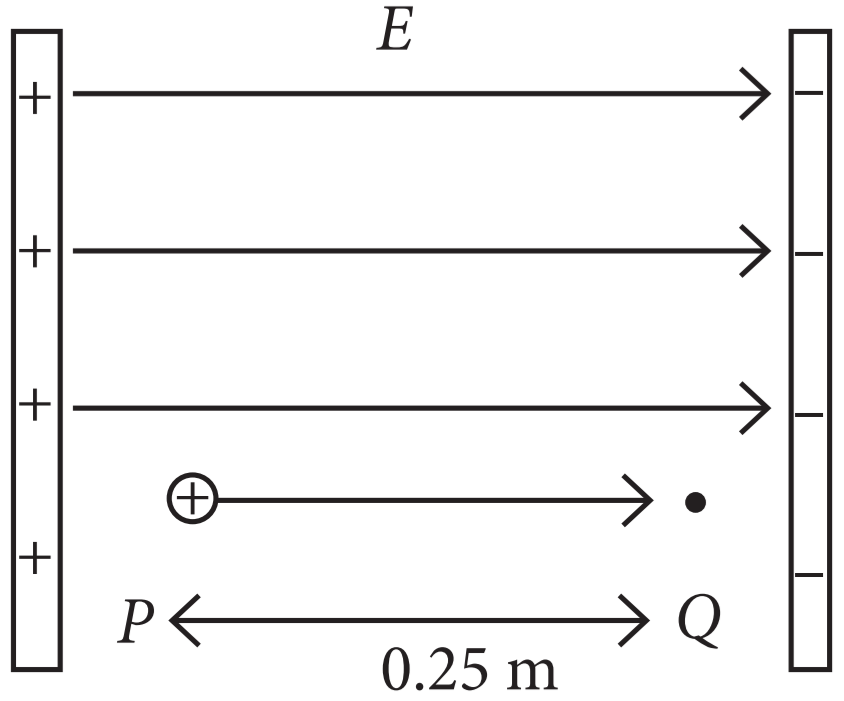
Potential difference $(\triangle\text{V})$ between two points A and B separated by a distance x, in a uniform electric field E is given by $\triangle\text{V}=-\text{Ex},$ where xis measured parallel to the field lines. If a charge q0 moves from P to Q, the change in potential energy $(\triangle\text{U})$ is given as $\triangle\text{U}=-\text{q}_0\triangle\text{V}.$ A proton is released from rest in uniform electric field of magnitude 4.0 × 108Vm-1 directed along the positive X-axis. The proton undergoes a displacement of 0.25m in the direction of E.

Mass of a proton = 1.66 × 10-27kg and charge of proton = 1.6 × 10-19C.

  1. The change in electric potential of the proton between the points A and B is:
  1. -1 × 108V
  2. 1 × 108V
  3. 6.4 × 10⁻¹⁹V
  4. -6.4 × 10⁻¹⁹V
  1. The change in electric potential energy of the proton for displacement from A to B is:
  1. 1.6 × 1011J
  2. 0.5 × 10²³J
  3. -1.6 × 10-11J
  4. 3.2 × 1022J
  1. The mutual electrostatic potential energy between two protons which are at a distance of 9 × 10-15m, in 92U235 nucleus is:
  1. 1.56 × 10-14J
  2. 5.5 × 10-14J
  3. 2.56 × 10-14J
  4. 4.56 × 10-14J
  1. If a system consistsoftwocharges 4mC and -3mC with no external field placed at (-5cm, 0, 0) and (5cm, 0, 0) respectively. The amount of work required to separate the two charges infinitely away from each other is:
  1. -1.1J
  2. 2J
  3. 2.5J
  4. 3J
  1. As the proton moves from P to Q, then:
  1. The potential energy of proton decreases.
  2. The potential energy of proton increases.
  3. The proton loses kinetic energy.
  4. Total energy of the proton increases.
Wavefront is a locus of points which vibratic in same phase. A ray of light is perpendicular to the wavefront. According to Huygens principle, each point of the wavefront is the source of a secondary disturbance and the wavelets connecting from these points spread out in all directions with the speed of wave.
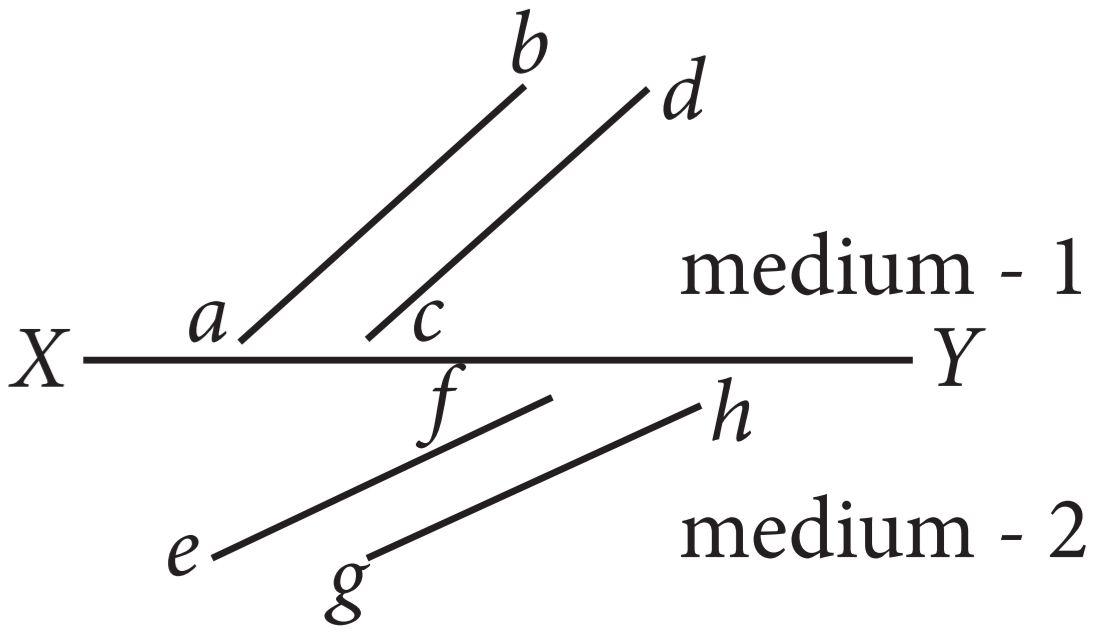
The figure shows a surface XY separating two transparent media, medium-I and medium-2. The lines ab and cd represent wavefronts of a light wave travelling in medium- 1 and incident on XY. The lines ef and gh represent wavefronts of the light wave in medium-2 after refraction.

  1. Light travels as a:
  1. Parallel beam in each medium.
  2. Convergent beam in each medium.
  3. Divergent beam in each medium.
  4. Divergent beam in one medium and convergent beam in the other medium.
  1. The phases of the light wave at c, d, e and f are $\phi_\text{c},\phi_\text{d},\phi_\text{e}$ and $\phi_\text{f}$ respectively. It is given that $\phi_\text{c}\not=\phi_\text{f}$
  1. $\phi_\text{c}$ cannot be equal $\phi_\text{d}$
  2. $\phi_\text{d}$ cannot be equal $\phi_\text{e}$
  3. $(\phi_\text{d}-\phi_\text{f})$ is equal to $(\phi_\text{c}-\phi_\text{e})$
  4. $(\phi_\text{d}-\phi_\text{c})$ is not equal to $(\phi_\text{f}-\phi_\text{e})$
  1. Wavefront is the locus of all points, where the particles of the medium vibrate with the same.
  1. Phase
  2. Amplitude
  3. Frequency
  4. Period
  1. A point source that emits waves uniformly in all directions, produces wavefronts that are:
  1. Spherical
  2. Elliptical
  3. Cylindrical
  4. Planar
  1. What are the types of wavefronts?
  1. Spherical
  2. Cylindrical
  3. Plane
  4. All of these.
A tangent galvanometer shows a deflection of 45° when 10mA of current is passed through it. If the horizontal component of the earth's magnetic field is BH = 3.6×10⁻⁵ T and radius of the coil is 10cm, find the number of turns in the coil.