MCQ
In an electromagnetic wave the energy density associated with magnetic field will be
  • A
    $\frac{1}{2}\,L{I^2}$
  • $\frac{{{B^2}}}{{2{\mu _0}}}$
  • C
    $\frac{{1\,}}{2}{\mu _0}{B^2}$
  • D
    $\frac{{1\,}}{2}\frac{{{\mu _0}}}{{{B^2}}}$

Answer

Correct option: B.
$\frac{{{B^2}}}{{2{\mu _0}}}$
b
Energy density due to electric field $=\frac{1}{2} \in E^{2}$

Energy density due to magnetic field $=\frac{1}{2} \frac{B^{2}}{\mu}$

since $\frac{E}{B}=c=\frac{1}{\sqrt{\in \mu}}$

Energy density is equally contributed to by electric and magnetic fields.

Need a full question paper?

Generate a complete, print-ready paper with questions like this in minutes — across 16+ boards, with answer keys.
Start Generating Free

Similar questions

Unit of relative permeability is:
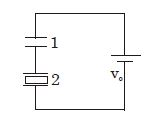
Two identical capacitors $1$ and $2$ are connected in series. The capacitor $2$ contains a dielectric slab of constant $K$ as shown. They are connected to a battery of emf $V_0\ volts$ . The dielectric slab is then removed. Let $Q_1$ and $Q_2$ be the charge stored in the capacitors before removing the slab and $Q'_1$ , and $Q'_2$ be the values after removing the slab. Then 
Consider telecommunication through optical fibres. Which of the following statements is $NOT$ true ?
In a hydrogen atom, which of the following electronic transitions would involve the maximum energy change
An electromagnetic wave with frequency $\omega $ and wavelength $\lambda $ travels in the $+ y$ direction . Its magnetic field is along $+\, x-$ axis. The vector equation for the associated electric field ( of amplitude $E_0$) is
A point charge $ + q$ is placed at the centre of a cube of side $L$. The electric flux emerging from the cube is
The potential at a point $P$ due to an electric dipole is $1.8\times 10^5\,V$ . If $P$ is at a distance of $50\,cm$ apart from the centre $O$ of the dipole and if $CP$ makes an angle $60^o$ with the positive side of the axial line of the dipole, what is the moment of the dipole?
In a Young's double-slit experiment, let $A$ and $B$ be the two slits. $A$ thin film of thickness $t$ and refractive index $\mu$ is placed in front of $A$. Let $\beta =$ fringe width. The central maximum will shift : 
The resistance of the series combination of two resistance is S. When they are joined in parallel the total resistance is P. If S = nP, then the minimum possible value of n is
If work function of metal is 3eV then threshold wavelength will be