Question
In deriving the single slit diffraction pattern, it was stated that the intensity is zero at angles of $\text{n}\lambda/\text{a}.$ Justify this by suitably dividing the slit to bring out the cancellation.

Answer

Let the slit width 'a' be divided into n equal parts of width 'a' so that,
$\text{a}'=\frac{\text{a}}{\text{n}}$
i.e., a = na'
Then,
$\text{Angle},\ \theta=\frac{\text{n}\lambda}{\text{a}}=\frac{\text{n}\lambda}{\text{na}'}$
$\text{i.e.},\ \theta=\frac{\lambda}{\text{a}'}$
At this derived angle, each slit will make first diffraction minimum. Hence, the resultant intensity for all slits will be zero at an angle of $\frac{\text{n}\lambda}{\text{a}}.$

Need a full question paper?

Generate a complete, print-ready paper with questions like this in minutes — across 16+ boards, with answer keys.
Start Generating Free

Similar questions

Is it necessary to have two waves of equal intensity to study interference pattern? Will there be an effect on clarity if the waves have unequal intensity?
The dielectric strength of air is $3.0 \times 10^6\ V/m.$ A parallel$-$plate air$-$capacitor has area $20\ cm^2$ and plate separation $0.10\ mm.$ Find the maximum rms voltage of an $AC$ source that can be safely connected to this capacitor.
Distinguish between intrinsic and extrinsic semiconductors. Although in an extrinsic semiconductor $n_e \neq n_h$, yet it is electrically neutral. Why?
Suggest a way to measure:
  1. The thickness of a sheet of paper.
  2. The distance between the sun and the moon.
A wheel is making revolutions about its axis with uniform angular acceleration. Starting from rest, it reaches 100rev/sec in 4 seconds. Find the angular acceleration. Find the angle rotated during these four seconds.
A vertical rod is hit at one end. What kind of wave propagates in the rod if:
  1. The hit is made vertically.
  2. The hit is made horizontally?
Is it possible to keep a parallel plate capacitor of capacity 1 Farad in your cupboard?
The magnetic force on a charged particle is always perpendicular to its velocity. Can the magnetic force change the velocity of the particle? Speed of the particle?
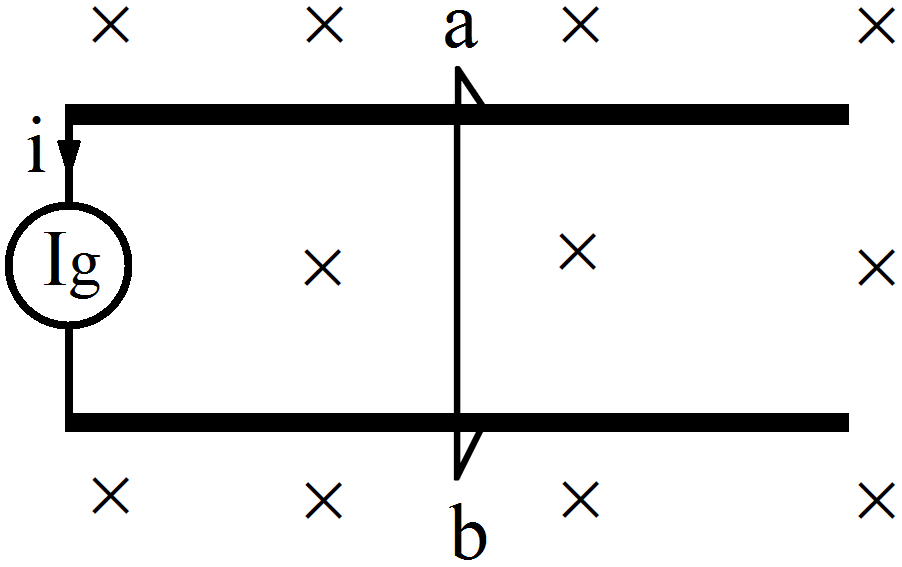
The current generator $I_g$ shown in figure, sends a constant current i through the circuit. The wire ab has a length l and mass m and can slide on the smooth, horizontal rails connected to $I_g$. The entire system lies in a vertical magnetic field $B$. Find the velocity of the wire as a function of time.
A copper wire of diameter 1.6 mm carries 20A. Find the maximum magnitude of the magnetic field $\overrightarrow{\text{B}}$ due to this current.