MCQ
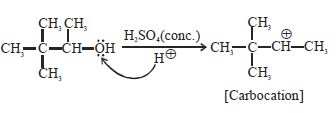
In following reaction Which type of reaction intermediate is likely to involve
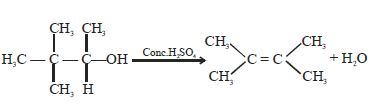
  • Carbocation
  • B
    Carbanion
  • C
    Crabon free radical
  • D
    Carbene

Answer

Correct option: A.
Carbocation
a

Need a full question paper?

Generate a complete, print-ready paper with questions like this in minutes — across 16+ boards, with answer keys.
Start Generating Free

Similar questions

For $\mathrm{A}_{2}+\mathrm{B}_{2} \rightleftharpoons 2 \mathrm{AB}$
$\mathrm{E}_{\mathrm{a}}$ for forward and backward reaction are 180 and $200 \mathrm{~kJ} \mathrm{~mol}^{-1}$ respectively
If catalyst lowers $\mathrm{E}_{\mathrm{a}}$ for both reaction by $100 \mathrm{~kJ} \mathrm{~mol}^{-1}$.
Which of the following statement is correct?
Which one of the following is wrongly matched
The electronic configuration of $\mathrm{Cu}$ (II) is $3 \mathrm{~d}^9$ whereas that of $\mathrm{Cu}(\mathrm{I})$ is $3 \mathrm{~d}^{10}$. Which of the following is correct?
Which bond angle $\theta $ would result in the maximum dipole moment for the triatomic molecule $YXY$
How many carbon atoms in the molecule $HCOO - {(CHOH)_2} - COOH$ are asymmetric
At higher altitude, boiling point of water is $95\,^oC$ . The amount of  $NaCl$ added to  $1\,\,kg$ water  $(K_b = 0.52\,\,Km^{-1})$  in order to raise the boiling point of solution to $100\,^oC$  (assume  $90\%$ ionisation of  $NaCl$ ) .......... $g$.
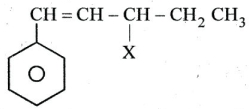
The given compound is an example of $..........$
Molecules in which all fluorine atoms are in same plane is
The ionisation constant of acetic acid is $1.8 \times 10^{-5}$. The concentration at which it will be dissociated to $2\%$, is
For the cell at $298\ K$

$Ag\left( s \right)\left| {AgBr\left( s \right)\,\left| {B{r^ - }\left( {0.01\,M} \right)} \right|\,\left| {{I^ - }\left( {0.02\,M} \right)} \right|\,AgI\left( s \right)} \right|Ag\left( s \right)$

the correct information is

[Given : $K_{sp}\,\left( {AgBr} \right) = 4 \times {10^{ - 13}}$ , 

$K_{sp}\,\left( {AgI} \right)$ $ = 8 \times {10^{ - 17}},\frac{{2.303\,RT}}{F} = 0.06\,V,\,\log \,2 = 0.3]$